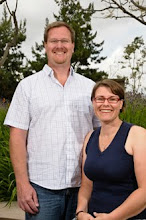
As I am equipping my children for the life God planned for them, God is equipping me for the life He planned for me.
Equip Academy
"May God himself, the God of peace, sanctify you through and through. May your whole spirit, soul and body be kept blameless at the coming of our Lord Jesus Christ." ~1 Thessalonians 5:23
Please feel free to add a comment and let me know you've been by. Thanks. ~ Sharon
I am in Christ; Jeff's wife; Joshua, Anna, Abigail and Samuel's mum. My husband pastors a Baptist church in a little country town in West Australia. I am, therefore, "the Pastor's Wife" - but I do not cook scones, play the organ, or {add your own stereotype here}. I love studying the Bible, because it helps me to love God more. I enjoy helping others engage more closely with the Bible, whether they be my own children, other children (in the past I have worked as a Children's Ministry Worker) or other women (leading Bible study small groups). I also enjoy my chickens and lambs.
I chose to read Gregor
the Overlander because it is written by the author of The Hunger Games but is written for younger kids like me. I enjoyed
reading this book because at every twist and turn of the book something
unexpected happened. It was also very funny in places.
Gregor lives in a New York apartment building, where
he discovers a way to go underground, to the Underland. There he finds a hidden
city, meets a princess, and goes on adventures with a giant rat, a giant bat, a
giant cockroach and his little sister Boots.
I recommend this book to people who like to read about
adventures, strange lands, prophecies, wars and dangerous quests. Gregor the Overlander is available from
our school library. There are four more books that continue the stories of
Gregor’s adventures. These may be borrowed as ebooks from the State Library of
WA.
Reviewed by Anna, age 9. (Anna wrote this for the school newsletter at the suggestion of our school librarian.)
I've been reading Swallowdale by Arthur Ransome aloud to the kids recently, and this morning they went off as shipwrecked sailors and explorers to the open scrub up the road from our house, on the edge of our town.
They carried the necessary rations in "knapsacks":
"pemmican" (twiggy sticks)
"grog" (cans of ginger beer)
bread and "bun loaf" (homemade bread)
"marmalade" (since there is a general disinclination to digest marmalade among our children, they settled on a jar with butter)
"apples all round" (apples - duh)
"chocolate rations (real chocolate, individual bars so there was no arguing)
and some cheese.
They also carried their own supplies. Anna, as Ship's Mate and Cook, carried the bulk of the rations as well as two plastic knives. Joshua, as Ship's Captain and leader of the expedition, carried the Ship's Knife on a belt, and also carried the Ship's Compass and Whistle for rallying the crew. Abigail was the Able Seaman, and she carried the digital camera for the Ship's Log (although she didn't do a very good job at taking photos, unfortunately) and Samuel, the Ship's Boy, carried the tarpaulin and octopus straps for shelter. Everyone wore gumboots and warm jumpers.
Here they are, ready to proceed up the "beck" (the little seasonal creek that goes under the road into town).
We've finally finished reading the Borrowers books by Mary Norton, taking four months to read 700+ pages of very small text, loving every night of reading aloud. Now I just need to work out what to read next! Any suggestions?
These holidays, as with previous holidays spent at home, our days have been ordered around two activities: swimming lessons in the morning and Individual Quiet Time aka Audiobook Hour after lunch.
We spent an hour a day for four weeks in the local pool and Sam passed Level 1 and Anna passed Level 4 and Level 5. Abigail practised Level 3 and Joshua struggled with floating and perfect form in Level 4. The physical exercise has been great for the kids.
Meanwhile, the quiet provided by an hour of kids in separate rooms reading their own books, or together in the lounge listening to an audiobook, has been great for me! Having something interesting to listen to has helped us all cope when 30+ and even 40+ temperatures have kept us cooped up inside for all but the very early and very late hours of our days.
(Jeff has also finished - after the better part of 2011 - reading aloud the Lord of the Rings trilogy by JRR Tolkein, and I've begun reading the Borrowers sextuplet. Our after dinner read alouds sometimes get missed in the business of term time, but we really get into them during holidays.)
This summer, we have enjoyed the following audiobooks, for most of which we are very thankful to our local public library:
The Jungle Book by Rudyard Kipling
James and the Giant Peach by Roald Dahl The BFG by ditto Charlie and the Chocolate Factory by ditto Charlie and the Great Glass elevator by ditto
Clarice Bean Spells Trouble by Lauren Child
Cry of the Cat by Emily Rhodda
Anne of Avonlea by LM Montgomery
We're finishing the holidays with The Incredible Journey by Shiela Burnford. It has indeed been an incredible literary journey.
At the breakfast table yesterday, Sam decided to tell me the story of Cinderella, beginning with the clock striking midnight:
Cinderella ran away from the ball room. She dropped her glass slipper. The man found it. He tried it on the other ones, Cinderella's friends. Then Cinderella tried it on. Everyone said, "It fits! It fits!"
Sam loves to listen to fairy tales. We borrowed two fairy tale books that came with CDs from the library and I had to renew them twice, I think; he and Abi liked them so much. He also enjoys listening to the Jesus Storybook Bible on CD (by Sally Lloyd-Jones, narrated by David Suchet), which is the kids' regular bedtime listening. Sam asks for that to be put on every night as soon as he is in bed. He can quote parts of it verbatim and sometimes plays games with me using the words from the JSBB. On Tuesday, our game went something like this:
Sam: "Mummy, you be the sleeping girl," (that would be Jairus's daughter*, Mark 5:21-42 and Luke 8:40-56) "and I will be Jesus." Me: "Okay." (Close eyes and lie still on the bed.) Sam: (Puts his hands on mine.) "Honey, it's time to get up!" Me: (Open eyes and smile.) "I'm better!"
Sam: "Now you be Jesus and I will be the sleeping girl." Me: "Okay."
Sam: (Closes eyes. Makes loud snoring sounds.) Me: "Honey, it's time to get up." Sam: (Stops snoring immediately. Opens eyes and sits bolt upright.) "I'm hungry!"
Sam: "Again, Mummy! Again!"
* From Luke 8: Meanwhile, all the people were wailing and mourning for her. "Stop wailing," Jesus said. "She is not dead but asleep." They laughed at him, knowing that she was dead. But he took her by the hand and said, "My child, get up!" Her spirit returned, and at once she stood up.
From the Jesus Storybook Bible, p219-220: Just then Jairus' servant rushed up to Jairus. "It's too late," he said breathlessly. "Your daughter is dead." Jesus turned to Jairus. "It's not too late," Jesus said. "Trust me." At Jairus' house, everyone was crying. But Jesus said, "I'm going to wake her up." Everyone laughed at him because they knew she was dead. Jesus walked into the little girl's bedroom. And there, lying in the corner, in the shadows, was the still little figure. Jesus sat on the bed and took her pale hand. "Honey," he said, "it's time to get up." And he reached down into death and gently brought the girl back to life. The little girl woke up, rubbed her eyes as if she'd just had a good night's sleep, and leapt out of bed. Jesus threw open the shutters and sunlight flooded the dark room. "Hungry?" Jesus asked. She nodded. Jesus called to her family, "Bring this little girl something breakfast!" Jesus helped and healed many people, like this. He made blind people see. He made deaf people hear. He made lame people walk. Jesus was making the sad things come untrue. He was mending God's broken world.
Cathy at The Best Book Co-Op is going to be hosting a collective reading of John Calvin's Institutes of the Christian Religion, through the Calvin Club.
I found a copy of Calvin's Institutes sitting on the family bookshelf: it is Volume 20 of Britannica's Great Books of the Western World series. Unfortunately, even at the Cathy's promised gentle pace (getting through Book I in 2010), I am not sure I will be able to partake. I have just applied to work part time, 2 1/2 days a week, as the Children's Ministry Worker at my church(!!). Not to mention the other project I am working on, writing a book. However, I would heartily recommend this challenge to anyone who would like to get a better grip on what they believe and why.
Hi to all of you wonderful regular readers of my blog!
Due to a sudden and unexpected - and delightful - turn of events, I have a pressing need to direct my writing energies elsewhere for a while, and maybe even the next few months. (If you want a hint, check out my tags for this post.) For that reason, I won't be posting on Equip Academy at least for the next fortnight, and probably (God willing!) until around mid-February 2010.
If it makes you feel any better, I'm giving up TV as well. Even though The Office is showing two nights a week at a manageable time starting this week!
Please keep me in your prayers. I look forward to writing for you again in 2010.
Grace, peace and love in Christ, Sharon
PS If you are hanging out for something else to read online, you might like to check out these blogs, which I will also be reading (some more frequently than others):
Amy Edward's blog Veritas at Home - an American homeschooling mum of four + one in-utero, who loves BSF like me and is a faithful Christian. (Did I mention Amy's blog shares a "birthday" with mine, and we have become great blogging buddies since we met online?)
Meredith's blog The Key to the Door - a fellow Perthite whose husband is a graduate of the same Theological College as mine, Meredith shares insights from her Bible reading and on Christian living.
John Granger's blog Forks High School Professor - for those who share with me a fascination in the deeper meanings buried in by Stephenie Meyer's Twilight Saga.
Kellie's blog Blue House Academy - another Christian homeschooler, whose American family is "touched by Austism".
For other recommendations, please check out the "Blogs I enjoy" and "Friends who blog" links in my left hand sidebar.
One of the things I love about reading books written before I was born is that they use language I am not familiar with, and my vocabulary is expanding gradually as I read these words, determine their meaning from their use in context (or from a dictionary if needs must) and then begin to deliberately look for opportunities to use them in my own conversations.
So here are the words I have learnt from my last week of reading. Note: None of the words from CS Lewis's works were in my dictionary, so I have given my initial presumed definition with (?).
From Heidi by Johnanna Spyri, originally written in German, originally published in 1880:
asseverated: [past tense verb] declared seriously, solemnly or earnestly. Heidi p2-3 " 'The child stay up there with Alm-Uncle! You must be out of your senses, Dete! ... That would be all very well if he were like other people,' asseverated stout Barbel warmly, 'but you know what he is. And what can he do with a child, especially with one so young!' " My usage: I had to summarise the words of Deut 32:46 for my BSF lesson last week. From the NIV: Deuteronomy 32:45 When Moses finished reciting all these words to all Israel, 46 he said to them, "Take to heart all the words I have solemnly declared to you this day, so that you may command your children to obey carefully all the words of this law. 47 They are not just idle words for you—they are your life. By them you will live long in the land you are crossing the Jordan to possess." I thought to myself, "Aha! Moses asseverated the Law to the people of Israel!" Bet you didn't know that, now, did you?
gape: [verb] to open mouth wide; to yawn. From dictionary.com, gape [verb] means "to open the mouth wide involuntarily, as the result of hunger, sleepiness, or absorbed attention" (Random House) Heidi p66 [Clara, the invalid, is speaking.] " 'You were expressly sent for to come here and to remain with me and share my lessons; there will be some fun about them now as you cannot read, something new to do, for they are dreadfully dull, and I think the morning will never pass away. You know my tutor comes every morning at about ten o'clock, and then we go on with lessons till two, and it does seem such a long time. Sometimes he takes up the book and holds it close up to his face, as if he was very short-sighted, but I know it's only because he wants so dreadfully to gape, and Fraulein Rottenmeir takes her large handkerchief out also now and then and covers her face with it, as if she was moved by what we had been reading, but that is only because she is longing to gape too. And I myself often want to gape, but I am obliged to stop myself, for if Fraulein Rottenmeir sees me gaping she runs off at once and fetches the cod-liver oil ... but now it will be so much more amusing...' " My usage: I already knew the definition of "gape" as in to open one's mouth wide, but I had never heard it applied to yawning before. FWIW, crocodiles gape, opening their mouths to allow air to flow into them as a means of cooling off.
From Perelandra: Voyage to Venus by Charles Staples (CS) Lewis, first published in 1943:
fissiparate: [verb] to divide a whole into two, particularly a pair of opposites (?) According to dictionary.com, fissiparity, aka schizogenesis, means "reproduction by fission" Ibid, fissiparous [adjective] means "producing new biological units or individuals by fission" (Meriam-Webster); "Reproducing or propagating by fission" (Stedman's Medical); and "2. Tending to break up into parts or break away from a main body; factious" (American Heritage Dictionary of the English Language) Ibid, related words breakaway, separatist (Visual Thesaurus) Perelandra p112 [Weston, possessed by the devil or one of his demons, is speaking.] " 'It is a most interesting thing in popular religion, this tendency to fissiparate, to breed pairs of opposites: heaven and hell, God and Devil.' "
miserific: [adjective] induces misery (?) Perelandra p135-136 "As there is one Face above all worlds merely to see which is irrevocable joy, so at the bottom of all worlds that face is waiting whose sight alone is the misery from which none who beholds it can recover. And though there seemed to be, and indeed were, a thousand roads by which a man could walk through the world, there was not a single one which did not lead sooner or later either to the Beatific Vision or the Miserific Vision." My usage: I have to admit, I don't want to have an opportunity to use miserific in conversation. Especially if the conversation is about my kids!
From That Hideous Strength: A Modern Fairy-Tale for Grown Ups by CS Lewis, first published in 1945:
neurasthenic: [noun] a person who suffers from a mental illness, with symptoms of lack of mental clarity and tiredness (?) From dictionary.com neurasthenic [noun] means "an individual affected with neurasthenia" (Meriam-Webster's Medical). Ibid, neurasthenia [noun] means "A psychological disorder characterized by chronic fatigue and weakness, loss of memory, and generalized aches and pains, formerly thought to result from exhaustion of the nervous system. No longer in scientific use." (American Heritage Dictionary of the English Language). That Hideous Strength p51 " 'I don't feel comfortable going away while you're in your present state -' 'What state?' said Jane, turning round and facing him [Mark, her husband] for the first time. 'Well - I mean - just a bit nervy - as anyone may be temporarily.' 'Because I happened to be having a nightmare when you came home last night - or rather this morning - there's no need to talk as if I was a neurasthenic.' " My usage: I woke up feeling like a neurasthenic yesterday, which may have been because I went to bed after midnight, having been absorbed in reading Perelandra.
seccotined: [past tense verb] attached by a fine connection, cf "hanging by a thread" (??) cf. sectile: able to be cut smoothly with a knife; -o- used as a connective to join compound words; -ine: pertaining to. That Hideous Strength p89-90 [Mrs Dimble, the kindly professor's wife, is speaking.] " 'There was an odious little man in a peaked cap who talked to Cecil with a cigarette in his mouth, at least it wasn't in his mouth but seccotined onto his upper lip - you know...' "
traducers: [plural adjectival noun] slanderers (?) From dictionary.com traduce means "to speak maliciously and falsely of; slander; defame: to traduce someone's character" (Random House); "To cause humiliation or disgrace to by making malicious and false statements" (American Heritage Dictionary of the English Language) That Hideous Strength p95 [Mr Straik, the "Mad Parson" is speaking.] " 'There will be resistance. They will gnaw their tongues and not repent. We are not to be deterred. We face these disorders with a firmness which will lead traducers to say that we have desired them. Let them say so. In a sense we have. It is no part of our witness to preserve that organisation of ordered sin which is called Society.' " My usage: Anyone who says that my vocabulary knowledge is merely up to high-school level is a mere traducer, do you hear?
Having finished reading Anne of Green Gables to the children, we are enjoying a selection of quality children's picture books from the local public library and our home library at the moment. One of our current favourites is Tom's Clockwork Dragon, by Jonathan Emmett, illustrated by Mark Oliver, from Oxford University Press.
This book gives an unusual rendering of the standard knight-errant-slays-dragon tale of yore. For a start, the knight errant is a young toymaker's apprentice who is fired in the second page of the book for spending all his time making clockwork toys rather than painting the master toymaker's toy puppets, as he has been asked... and the traditional damsel-in-distress character is instead the daughter of an armour-maker who has some interesting skills of her own.
Tom's Clockwork Dragon does suffer from a lack of strong and good adult characters and completely absent parents, as in many children's books nowadays. It also has one or two slightly awkward hiccups in its generally poetical prose. However, the kids have loved its inventive plot and asked me to read it many times since we borrowed it from the public library nearly four weeks ago.
One thing I have enjoyed is a particular plot twist reminiscent of the biblical story of David and Goliath from 1 Samuel 17. See if you can pick the connection (click on the image to see it larger):"The King nearly fell off his throne laughing when Tom turned up at the palace. 'The advert was for a brave knight not a foolish boy,' he said, wiping his eyes. 'But since all the real knights have been eaten by the dragon, I suppose you might as well try. But you need to be properly dressed,' he added. 'Go and ask the armourer to knock up a suit in your size.'"
Does it remind you of David approaching King Saul with his offer to fight the giant, Goliath?
David received the same response from his king as Tom does in this story: "You'll need some armour." Neither David nor Tom end up wearing armour when they approach their foes. Tom finds that the "armoury was empty except for a young girl, named Lizzie." She does not furnish him with armour, but instead gives him the spark for an idea of how the dragon might be defeated.
By way of contrast, 1 Samuel 17:38-40 tells us, "Saul dressed David in his own tunic. He put a coat of armor on him and a bronze helmet on his head. David fastened on his sword over the tunic and tried walking around, because he was not used to them. "I cannot go in these," he said to Saul, "because I am not used to them." So he took them off. Then he took his staff in his hand, chose five smooth stones from the stream, put them in the pouch of his shepherd's bag and, with his sling in his hand, approached the Philistine."
In the end, it is Tom's wits and Lizzie's skills at her father's forge that enable them to defeat the dragon Flamethrottle. In the biblical story, it wasn't David's wits that enabled him to defeat Goliath. Nor was it his courage or even his fine aim and years of experience killing bears and lions with his sling shot, as most people would probably remember from their Sunday School lessons. Rather, it was David's true King, the LORD God Almighty, who delivered David from the hand of Goliath the Philistine. 1 Samuel 17:45-51 says,
"David said to the Philistine, "You come against me with sword and spear and javelin, but I come against you in the name of the LORD Almighty, the God of the armies of Israel, whom you have defied. This day the LORD will hand you over to me, and I'll strike you down and cut off your head. Today I will give the carcasses of the Philistine army to the birds of the air and the beasts of the earth, and the whole world will know that there is a God in Israel. All those gathered here will know that it is not by sword or spear that the LORD saves; for the battle is the LORD's, and he will give all of you into our hands." As the Philistine moved closer to attack him, David ran quickly toward the battle line to meet him. Reaching into his bag and taking out a stone, he slung it and struck the Philistine on the forehead. The stone sank into his forehead, and he fell facedown on the ground. So David triumphed over the Philistine with a sling and a stone; without a sword in his hand he struck down the Philistine and killed him. David ran and stood over him. He took hold of the Philistine's sword and drew it from the scabbard. After he killed him, he cut off his head with the sword."
David did pick up the stones. He did throw them with his sling shot. It was those stones that knocked Goliath unconscious long enough for David to cut off his head with Goliath's own sword. But it was not by David's own power and strength David did this. Nor was it for David's own glory that he did it. The battle was won by the LORD. The battle was won for the glory and honour of the name of the LORD God Almighty, so that Goliath could no longer "defy the armies of the living God" (as David described it in 1 Samuel 17:26).
The best thing about this is that David knew all along that it would be the LORD who would save him from Goliath. While Tom spent much of the story frightened of Flamethrottle, even while he was volunteering to fight him, David was confident of success from the outset. David knew that the LORD had delivered him from bears and lions before, when he worked as a shepherd guarding his father's sheep. When he faced Goliath on the battlefield, David was already proclaiming praises to the glory of the living God, who had sovereign control over the battle's outcome.
Which all makes for a much better ending than "The King was pleased to be rid of the real dragon and delighted when Tom and Lizzie presented him with the clockwork dragon as well. It made a wonderful royal carriage for parades." Tom went on to make toy-sized clockwork dragons. But David went on to become a royal servant of of the One True God. I know which one I would rather be! And, wonder of wonders, through Jesus Christ, that is exactly what I am.
Peter wrote of Christians (1 Peter 2:9), "But you are a chosen people, a royal priesthood, a holy nation, a people belonging to God, that you may declare the praises of him who called you out of darkness into his wonderful light." Now that is a real Happily Ever After!
We are finally finished reading Anne of Green Gables by Lucy Maud Montgomery. It only took us six months!
Joshua said the first time we read from the novel, "She talks a lot!" Throughout the book, we found that Anne, and the other characters, had much of interest to say. It was a beautiful book for gently and humorously teaching many practical and moral lessons. It also provided fodder for a variety of discussions. It was easy to speak of the folly of doing what your friends "dare" you to do, when we remembered together what had happened to poor Anne in the incident where "Anne Comes to Grief In an Affair of Honour", requiring seven weeks of recovery in bed.
Here's a selection of my favourite quotes from the book:
"You'd find it easier to be bad than good if you had red hair," Anne said reproachfully. "People who haven't red hair don't know what trouble is." ...
"It gives you a lovely, comfortable feeling to apologize and be forgiven, doesn't it? " ...
"Saying one's prayers isn't exactly the same thing as praying." ...
"But I'd rather look ridiculous when everybody else does than plain and sensible all by myself," persisted Anne mournfully." ...
"Oh, Marilla," exclaimed Anne... "Five minutes ago I was so miserable I was wishing I'd never been born and now I wouldn't change places with an angel!" ...
"Marilla, I do not think she is a well-bred woman. There is nothing more to do except to pray and I haven't much hope that that'll do much good because, Marilla, I do not believe that God Himself can do very much with such an obstinate person as Mrs Barry." ...
"Ten minutes isn't very long to say an eternal farewell in," said Anne tearfully." ...
"I'll try to be a model pupil," agreed Anne dolefully. "There won't be much fun in it, I expect. Mr Phillips said Minnie Andrews was a model pupil and there isn't a spark of imagination or life in her." ...
The rivalry between them was soon apparent; it was entirely good-natured on Gilbert's side; but it is much to be feared that the same thing cannot be said of Anne, who had certainly an unpraiseworthy tenacity for holding grudges. ...
Mr Phillips might not be a very good teacher; but a pupil so inflexibly determined on learning as Anne was could hardly escape making progress under any kind of a teacher. ... In geometry Anne met her Waterloo. "It's perfectly awful stuff, Marilla," she groaned. ... "There is no scope for imagination in it at all." ...
"I'm so glad Mrs Hammond had three pairs of twins after all. If she hadn't I mightn't have known what to do for Minnie May. I'm real sorry I was ever cross with Mrs Hammond for having twins." ...
"I assure you, Marilla, that I feel like praying to-night and I'm going to think out a special brand-new prayer in honour of the occasion." ...
"Mrs Lynde says that sound doctrine in the man and good housekeeping in the woman make an ideal combination for a minister's family."
"I'm afraid concerts spoil people for everyday life. I suppose that is why Marilla disapproves of them. Marilla is such a sensible woman. It must be a great deal better to be sensible; but still, I don't believe I'd really want to be a sensible person, because they are so unromantic. Mrs Lynde says there is no danger of my ever being one, but you can never tell. I feel just now that I may grow up to be sensible yet. But perhaps that is only because I'm tired." ...
"Just think, Diana, I'm thirteen years old today," remarked Anne in an awed voice. "...In two more years I'll be really grown up. It's a great comfort to think that I'll be able to use big words then without being laughed at." ...
"Mrs Allan says we should never make uncharitable speeches; but they do slip out so often before you think, don't they? I simply can't talk about Josie Pye without making an uncharitable speech, so I never mention her at all. You may have noticed that."...
"Diana, even ministers are human and have their besetting sins like everybody else." ...
"I've found out what an alabaster brow is. That is one of the advantages of being thirteen. You know so much more than you did when you were only twelve." ...
"I thought nothing could be as bad as red hair. But now I know it's ten times worse to have green hair." ...
"It makes you feel very virtuous when you forgive people, doesn't it?" ...
"I mean to devote all my energies to being good after this and I shall never try to be beautiful again. Of course it's better to be good. I know it is, but it's sometimes so hard to believe a thing even when you know it."
"I'm just dazzled inside," said Anne. I want to say a hundred things, and I can't find words to say them in. ... I'm not vain, but I'm thankful."
"We are rich," said Anne staunchly. "Why, we have sixteen years to our credit, and we're happy as queens, and we've all got imaginations, more or less. Look at that sea, girls - all silver and shallow and vision of things not seen. We couldn't enjoy its loveliness any more if we had millions of dollars and ropes of diamonds. You wouldn't change into any of those women if you could. Would you want to be that white-lace girl and wear a sour look all your life, as if you'd been born turning up your nose at the world? Or the pink lady, kind and nice as she is, so stout and short that you'd really no figure at all? Or even Mrs Evans, with that sad, sad look in her eyes? She must have been dreadfully unhappy some time to have such a look. ... I don't want to be anyone but myself, even if I go uncomforted by diamonds all my life," declared Anne. "I'm quite content to be Anne of Green Gables, with my string of pearl beads. I know Matthew gave me as much love with them as ever went with Madame the Pink Lady's jewels."
"Oh, it's delightful to have ambitions. I'm so glad to have such a lot. And there never seems to be an end to them - that's the best of it. Just as soon as you attain to one ambition you see another one glittering higher up still. It does make life so interesting."
As Marilla said to Matthew: "That child is hard to understand in some respects. But I believe she'll turn out all right yet. And there's one thing certain, no house will ever be dull that she's in."
Towards the end of the novel, there is the following intimate exchange between Anne and her adoptive father, Matthew. It illustrates the love of a family beautifully. "You've been working too hard to-day, Matthew," she said reproachfully. "Why won't you take things easier?" "Well now, I can't seem to," said Matthew, as he opened the yard gate to let the cows through. "It's only that I'm getting old, Anne, and keep forgetting it. Well, well, I've always worked pretty hard and I'd rather drop in harness." "If I'd been thr boy you sent for," said Anne wistfully, "I'd be able to help you so much now and spare you in a hundred ways. I could find it in my heart to wish I had been, just for that." "Well now, I'd rather have you than a dozen boys, Anne," said Matthew patting her hand. "Just mind you that - rather than a dozen boys."
We are reading through Anne of Green Gables as a family after dinner some evenings, and I have already provided some choice quotes on those in Christian ministry. That post sparked quite some hilarity from my fellow Ministry Wife from Perth, Meredith.
The condemnation for a minister's wife who has Puffed Sleeves (horror of horrors!) is funnier when you realise that in a recent chapter, Matthew goes to Mrs Lynde and organises for Anne to receive a new dress for Christmas, that has puffed sleeves, to Marilla's dismay. Matthew had observed Anne with her friends and noticed something was different, and then set out to rectify the situation, despite his agreement with Marilla that she was to be solely responsible for the raising of Anne.
Earlier in the novel, when Marilla and Anne were discussing Marilla's choice of clothes for Anne, the matter of puffed sleeves had come up as well. Marilla expressed disapproval. Anne responds, in one of the quotes I have in my blog's RHS column at the moment.
"But I'd rather look ridiculous when everybody else does than plain and sensible all by myself," persisted Anne mournfully.
Fortunately, I must say, Anne's opinions of the necessity of beauty are somewhat tempered the events of the novel. Of far more aggravation than any issue of Puffed Sleeves is the dire situation of Anne's red hair which shows no signs of darkening to auburn. (Sorry if this is getting too personal, Amy.) So Anne industriously purchases some hair dye from a travelling salesman, but it doesn't turn her hair the guaranteed "raven black".
"I thought nothing could be as bad as red hair. But now I know it's ten times worse to have green hair."
"I mean to devote all my energies to being good after this and I shall never try to be beautiful again. Of course it's better to be good. I know it is, but it's sometimes so hard to believe a thing even when you know it."
We are reading through Anne of Green Gables as a family after dinner some evenings, and I am finding some unique and hilarious insights into opinions of those who enter Christian ministry within the pages. Mrs Rachel Lynde, ever ready with a word on many subjects, has had several things to say. Anne's take - on Mrs Lynde's opinions and the matters themselves - is at times wise beyond her years.
For those who are not familiar with the Anne books, Marilla and Matthew are Anne's adoptive parents; Mr and Mrs Allan are the newly wed, newly arrived to Avonlea, minister and his wife.
"We met the new minister and his wife coming from the station. For all I was feeling so bad about Mr Phillips going away I couldn't help taking a little interest in a new minister, could I? His wife is very pretty. Not exactly regally lovely, of course, - it wouldn't do, I suppose, for a minister to have a regally lovely wife, because it might set a bad example. Mrs Lynde says the minister's wife over at Newbridge set a very bad example because she dresses so fashionably. Our new minister's wife was dressed in blue muslin with lovely puffed sleeves and a hat trimmed with roses. Jane Andrews said she thought puffed sleeves were too worldly for a minister's wife, but I didn't make any such uncharitable remark, Marilla, because I know what it is to long for puffed sleeves. Besides, she's only been a minister's wife for a little while, so one should make allowances, shouldn't they?"
Old Mr Bentley, the minister whom Anne had found lacking in imagination, had been pastor of Avonlea for eighteen years. He was a widower when he came, and a widower he remained, despite the fact that gossip regularly married him to this, that, or the other one, every year of his sojourn. In the preceding February he had resigned his charge and departed amid the regrets of his people, most of whom had the affection born of long intercourse for their good old minister in spite of his short-comings as an orator. Since then the Avonlea church had enjoyed a variety of religious dissipation in listening to the many and various candidates and 'supplies' who came Sunday after Sunday to preach on trial. These stood or fell by the judgement of the fathers and mothers in Israel; but a certain small, red-headed girl who sat meekly in the corner of the old Cuthbert pew also had her opinions about them and discussed the same in full with Matthew, Marilla always declining from principle to criticize ministers in any shape or form. "I don't think Mr Smith would have done, Matthew," was Anne's final summing up. "Mrs Lynde says his delivery was so poor, but I think his worst fault was just like Mr Bentley's - he had no imagination. And Mr Terry had too much; he let it run away with him just as I did mine in the matter of the Haunted Wood. Besides, Mrs Lynde says his theology wasn't sound. Mr Gresham was a very good man and a very religious man, but he told too many funny stories and made the people laugh too much; he was undignified, and you must have some dignity about a minister, mustn't you, Matthew? I thought Mr Marshall was decidedly attractive; but Mrs Lynde says he isn't married or even engaged, because she made special inquiries about him, and she says it would never do to have a young unmarried minister in Avonlea, because he might marry in the congregation, and that would make trouble. Mrs Lynde is a very far-seeing woman, isn't she, Matthew? I'm very glad they've called Mr Allan. I liked him because his sermon was interesting and he prayed as if he meant it and not just as if he did it because he was in the habit of it. Mrs Lynde says he isn't perfect, but she says she supposes we couldn't expect a perfect minister for seven hundred and fifty dollars a year, and anyhow his theology is sound because she questioned him thoroughly on all the points of doctrine. And she knows his wife's people and they are most respectable and the women are all good housekeepers. Mrs Lynde says that sound doctrine in the man and good housekeeping in the woman make an ideal combination for a minister's family."
"I'm not half so skinny as I was when I came here, but I have no dimples yet. If I had perhaps I could influence people for good. Mrs Allan said we ought always try to influence other people for good. She talked so nice about everything. I never knew before that religion was such a cheerful thing. I always thought it was kind of melancholy, but Mrs Allan's isn't, and I'd like to be a Christian if I could be one like her. I wouldn't want to be one like Mr Superintendent Bell." "It's very naughty of you to speak so about Mr Bell," said Marilla severely. "Mr Bell is a real good man." "Oh, of course he's good," agreed Anne, "but he doesn't seem to get any comfort out of it. If I could be good I'd dance and sing all day because I was glad of it. I suppose Mrs Allan is too old to dance and sing and of course it wouldn't be dignified in a minister's wife. But I can just feel she's glad she's a Christian and that she'd be one even if she could get to heaven without it."
"I hope I shall be a little like Mrs Allan when I grow up. Do you think there is any prospect of it, Marilla?" "I shouldn't say there was a great deal," was Marilla's encouraging answer. "I'm sure Mrs Allan was never such a silly, forgetful little girl as you are." "No; but she wasn't always so good as she is now either," said Anne seriously. "She told me so herself - that is, she said she was a dreadful mischief when she was a girl and was always getting into scrapes. I felt so encouraged when I heard that. Is it very wicked of me, Marilla, to feel encouraged when I hear that other people have been bad and mischievous? Mrs Lynde says it is. Mrs Lynde says she always feels shocked when she hears of anyone ever having been naughty, no matter how small they were. Mrs Lynde says she once heard a minister confess that when he was a boy he stole a strawberry tart out of his aunt's pantry and she never had any respect for that minister again. Now I wouldn't have felt that way. I'd have thought that is was real noble of him to confess it, and I'd have thought what an encouraging thing it would be for small boys nowadays who do naughty things and are sorry for them to know that perhaps they may grow up to be ministers in spite of it."
Literacy Anna has read a half dozen more pages of Sparky the Space Chimp (ER#5) but still not finished it. I really need to sit down with her for some long slabs of time to listen to her read but we have somehow fallen out of the habit. She has continued to progress with Reading Eggs but her free subscription expired last weekend and we have yet to decide if we will purchase her a proper subscription. Abigail has read Sam (BB#1.2) and Dot (BB#1.3). She has also completed another half dozen pages from LEM Phonics Workbook 1. Anna has been doing more copywork and less tracework. Her tasks have ranged from five lines of copywork, which was one long sentence from her narration of Thumbeline (by Hans Christian Andersen) and six lines of copywork from Mark 10:32-34 (she still has another 12 lines to complete the passage).
Literature We have read quite a few Hans Christian Andersen tales: Thumbeline, The Tinderbox, The Sandman, The Jumpers, The Rose Tree Regiment, The Naughty Boy, The Swineherd, The Emperor's New Clothes, The Real Princess aka The Princess and the Pea, The Nightingale, The Little Match Girl and The Red Shoes. The girls betook themselves to the Nursery Rhyme books one day as well. I have continued reading aloud Anne of Green Gables to the extent where Anna just named a new Dolly that she won last weekend "Anne". Jeff has read aloud a much shortened version of Around the World in 80 Days which did incite interest. We have also shared a few picture books from our home library and Jeff has read at least three Asterix comics to the children. These last are Joshua's choice from the school library, but the girls are enjoying them as well, as I am noticing from a few additions to their vocabulary.
Mathematics Anna has completed the chapters on shapes (Ch7) and measuring length (Ch8) from Primary Mathematics 1A and will be moving on to the chapters on Halves and Quarters, Time, Money and possibly Graphing from 1B over the next two months. I ordered Earlybird Mathematics 1B (the second semester Kindergarten-level course from Singapore that Joshua and Anna used together last year at the Pre-Primary level) from Chariot Press at the CHESS conference on Saturday. Abigail will begin work from that as soon as it arrives, and leave the rest of the Nursery Rhyme maths books, which is similar to what I did with the older two. I picked the 1B to start with since that has less on numbers (which she is fairly adept with) and more on shapes and time and other practical mathematics, which Abi is less knowledgeable in. Of course, we will continue to use the Maths Mastermind hands-on materials and their tasks, which she enjoys.
Bible Abigail and Anna did some tracework/copywork from Hebrews 13:17 to present to their BSF Children's Leaders, as I wrote about at the bottom of this post. Anna chose to memorise Mark 10:32-34 to recite at our evening church service last Sunday, when Jeff was preaching from that passage (and the surrounding passages). She did a marvellous job of reciting in front of 12 unrelated adults, having already practised on such willing listeners as Dad, Granny, Mrs D (from Women's Gathering), Mrs Felicity (our BSF Teaching Leader) and Mr K (one of our elders). I learnt the passage along with her: They were on their way up to Jerusalem with Jesus leading the way and the disciples were astonished, while those who followed were afraid. Again he took the Twelve aside and told them what was going to happen to them. "We are going up to Jerusalem," he said, "and the Son of Man will be betrayed to the Chief Priests and teachers of the Law. They will condemn him to death and hand him over to the Gentiles who will mock him and spit on him, flog him and kill him. Three days later he will rise."
Other We have also made time for a little bit of craft and Joshua has been working with Jeff to make a Zoo for his "XYZ project" for the school open evening this week.
Social Last Thursday two families from the Women's Gathering came over to our Play Room for lunch and a play afterwards, which was a lovely time to get to know one another better and encourage each other. Abigail had a play day with her friend I on Saturday, while Anna had a play day with her friend R. The boys spent the morning at the church Busy Bee doing a big job of backyard clean up in the house next door to the church which is owned by the church and rented out. Apparently the boys had a great time, Josh with an axe and Sam with some secateurs (can you tell I wasn't present?!?) and their toy lawn mower. I spent the day with several friends at the Christian Homeschool Seminar and Show. The talks were only so-so, but I was able to purchase the Earlybird Mathematics curriculum for Abigail that I used with Joshua and Anna last year, which pleased me immensely. The company I had purchased those books from previously is MIA. I was also able to examine the LEMP Phomics Workbook 3 and purchase that to do orally with Anna over the next two months (as review); Abigail will write in it when her turn comes to use it some time next year. I am writing this post Monday evening. Since Friday evening, one or more of us have been involved in 15 different events, not including school attendance. The outings ranged from the Boys' Brigade Aladdin dinner Pantomime on Saturday evening (we only got the kids into bed at 10:30pm!!) to lunch with the F & B families from church on Sunday, after the morning service and the church AGM. Josh and Anna both had Brigades this evening and Jeff and I both had separate meetings tonight; fortunately mine was here at home! But as you might imagine, I am exhausted, mentally and emotionally. So now I am going to bed.
As per my Mum's request, I am going to be writing more on the blog again about our homeschooling efforts. I have settled into our pattern, and it hadn't seemed interesting enough to write about from my perspective, but she reminded me that I am teaching different children now, and it is good to be providing a diary of sorts for myself and for interested parties such as grandparents. And Mum does have a point. My last Weekly Report was way back in week 2 of term 1! So here we are again... Granny was staying with us all this week, but didn't spend much time with us until Thursday, because she was visiting Gramps each day. He has been in hospital here in Perth, having had a heart attack last Saturday night. Gramps was operated on on Tuesday, and had five stents put in three blood vessels near his heart. He was discharged on Thursday and we were at last able to spend a little time with him (see below). Unfortunately, Gramps still needs at least one more stent put in, so he will be back for another operation in a fortnight. It has been a privilege to care for my MIL while she deals with Gramps's dramatic health concerns, after all the help and prayer our family has been given over the last month. As Paul wrote (2 Corinthians 1:3-6), "Praise be to the God and Father of our Lord Jesus Christ, the Father of compassion and the God of all comfort, who comforts us in all our troubles, so that we can comfort those in any trouble with the comfort we ourselves have received from God. For just as the sufferings of Christ flow over into our lives, so also through Christ our comfort overflows. If we are distressed, it is for your comfort and salvation; if we are comforted, it is for your comfort, which produces in you patient endurance of the same sufferings we suffer."
Monday We took a morning trip to the library. We read some books there and borrowed a few to bring home, including Lauren't de Brunhoff's Babar's Little Girl, which has re-ignited Babar-fever in our sweet Abigail. Abigail worked through pp5-6 of LEM Phonics 1 book and re-read Bob Book #1.2 Sam. I have decided to have Abi do her phonics pages in order that the letters are introduced in the Bob Books, so we are hopping around a bit. After Abi has completed the relevant phonics work, she reads the book. It is taking her several days' worth of lessons to get through the phonics behind each Bob Book, so she is re-reading them quite a number of times before moving on to the next. Each time she reads the books, she gets a little better. At this stage she isn't feeling frustrated, but rather pleased with her accomplishment. I am not feeling like I should be moving her through faster. Joshua and Anna read shorter home-made reading books (one sentence a day) when I was introducing them to the Basic Code, but I wasn't using the LEM Phonics materials with them either. I think this is a good fit for Abigail. Abigail is doing well with blending, but the pace is allowing her to focus on learning and recognising each new letter. Also, while she can blend simple CVC words, she still finds it hard to segment words (sound them out from hearing the word, not seeing it written) into their individual sounds without running two sounds together, thus: mat is sounded m+at or ma+t, rather than m+a+t. It is really quite fascinating to see how well she has come along so far this term, since we began about six weeks ago (with time out for illness) to introduce her to the Basic Code and reading VC and CVC words. And when I look ahead in my mind and see her reading as well as Anna and Joshua do, I am excited to be teaching my own child to read, once again. Abigail also worked through half of the pages of the Singaporean kindergarten-level Mathematics book Baa Baa Black Sheep, using the skills of counting 0-5, using the terms "one"/"many" and "enough". Anna read pp44-47 from Endeavour Reader #5, Sparky the Space Chimp. She also went to Girls' Brigades in the evening (and so was required to have a rest in the afternoon, hence she didn't do much in the way of academics).
Tuesday In the morning, we collected Grandma from the airport, only for an overnight stopover this time, on her way home to Darwin. We took Grandma for a tour of Joshua's school, where she was able to see Joshua working and see the pre-primary class that Anna will be joining for the last five weeks of term 4. In the afternoon, Abigail completed pp9-10 or her phonics book and pp22-26 of Baa Baa Black Sheep, using the terms "same"/"different". Meanwhile, Grandma and Anna were working on a jigsaw of three chameleons, which provided a nice topic for an extended conversation about the characteristics of some of the Animal Classes. Both Anna and Abigail joined in this conversation, and while Anna had a sound understanding at the end, which she was able to demonstrate to Dad over dinner that night, Abigail found it a bit confusing. Anna's penmanship task for the day was based on this Science lesson. For copywork: "Birds have feathers. Mammals have fur. Reptiles have scales." For tracework: "Zebras and tigers are ___. Chickens and ducks are ___. Snakes and turtles are ___." Anna completed this penmanship with Grandma's oversight while I went to collect Joshua, and apparently she had no trouble reading the sentences or working out what word to use in the blanks. Grandma also helped Anna with her mathematics lesson, from Primary Mathematics 1A #7.1 pp69-75, and Ex50 from the Student Workbook 1A(2). It was Anna's first lesson on shapes, and we are moving through faster than previously because she is quite familiar with these ideas, and much of it is review. Since Anna has now completed the number skills chapters to the stage of being able to add and subtract within 20 (competently with manipulatives and sometimes without), we are leaving the remaining number skills chapters and skipping to the chapters on shapes, length, halves & quarters, time, money and perhaps weight and graphs, in order to complete these before she begins at away-school. If I was going to continue teaching Anna at home, we would just keep going steadily through the Primary Mathematics 1 books into next year, but I think most of the number skills of 1B are beyond her at this stage, while the space and measurement skills are at an appropriate level as well as being useful.
Wednesday This is our BSF day. After dropping Grandma back at the airport and Granny at the hospital, I was back home in time to hand the car keys to Jeff so he could drive Joshua to school on time: by 8:35am! At BSF, we studied Numbers 13-14, the tragic story of the unbelief of Israel when they listened to the report of the spies who had been into the Promised Land, and focussed on the "giants" in the land who would oppose them, rather than listening to Caleb and Joshua and placing their faith in the greatness of God who would go before them in all His mighty power. Jeff met us at the church and collected the kids from me. We have one child in each of the BSF classes: Samuel is in the 2yo class, Abi in the 3yo class, and Anna is one of the eldest children in the 4-5yo class. When Anna begins away-school, she will have spent over three-and-a-half years in the BSF programs! The Children's Leaders have been an immense blessing in Anna's life, as for all our children. Without the kids, I was able to attend the Homiletics Seminar, as I have already blogged. That evening, I read the children four picture books, one for each of them: Madeline by Ludwig Bemelmans, Where's Stripey? by Wendy Binks, Jungle Drums by Graeme Base and I Love My Mummy by Sebastien Brown. All of these picture books came from our own home library, and most were gifts from family. I think Where's Stripey was the favourite of the night, with the children joining in with me for the repeated refrain as Stripey's father, Crikey, asked other bush creatures if they had seen his son. The names of places and characters are delightful. I offer you a taste: So Crikey ran on, past Musselduck Crossing and over Dingbat Ditch, where he saw the two kookaburras Smirk and Giggle, who were laughing their heads off. "Hey, guys," he called to them once they'd stopped laughing, "have you seen my chick? His name is Stripey." "What does he look like? Asked Smirk. "Does he look like you?" "No," said Crikey, "he is small and fluffy - and stripey." "No, sorry," Smirk and Giggle replied together, "we haven't seen him." The pictures are delightful as well:
Thursday This is our Women's Gathering Day. Jeff dropped Joshua at school then took the younger children to church, while I collected another woman to bring her to church. It was a small group of five this week (the smallest it has been since we started), but that was great. It gave me an opportunity to see how the changes I had made in the structure of the study (embedding Connect questions within the Content section, rather than leaving them all to the end) worked well: it did. The children joined with their friend C in having Kids' Gathering with Jeff, studying Acts 13:13-52. He told them the story of Paul and Barnabas in Psidian Antioch, when the Jews responded to Paul's proclamation of the good news of salvation through Jesus with contempt, but the Gentiles heard the word of God with gladness and believed. Each week I provide a colouring picture to help them visualise the scene. This week's picture I altered slightly from the original black line master, which was intended to be Jesus preaching at Nazareth:When we got home from WG, the kids were delighted to find Granny had brought Gramps home from the hospital. They cuddled around him on the recliner, with me intervening when it seemed they would bump him too hard or lean over him too heavily and cut off the circulation to his legs. Gramps even managed to read a few stories to the eager children: The Princess and the Pea and The Emperor's New Clothes by Hans Christian Andersen. Granny provided lunch and then she cooked Magic Broth (aka vegetable soup, the alias is hoped to help Abigail want to eat it though she really doesn't like soup) with Anna's careful help and increasingly skilful efforts with the vegie peeler. The girls and Joshua played with Maths Mastermind later on, Abigail working with the beads and Anna with the shapes.
Friday Before everyone left in the morning, I took some photos of the kids. With only a few days left of winter, I have finally got their winter homeschool excursion clothes made, so after Joshua left for school we had some more fun (and a whole lot of frustration as well) taking some more Equip Academy photos. Since it is apparently "Book Week", the local library was having a special treat for their Story Hour, which we don't usually attend. We watched a Patch Theatre production of "The Frog Prince". Well, I watched. All three of the kids, along with a friend from Sunday School who was there with her mother, were chosen to be part of the cast. So they didn't just watch, but joined in! Anna was dubbed Lady Spice and Abigail was Lady All Things Nice... can you guess where the names came from? Any predictions for Samuel? He was Lord Slugs! The children loved the story, and the girls really took it all in, as they showed later when they narrated it back while Sam had his nap. Anna's narration provided her penmanship task for the day, and I read The Frog Prince from my JLC & WC Grimm anthology as well. One of the things I noticed about this story is that the original has an extended end that is deleted from every children's version I have ever heard. After the happy couple marry, they are driven home to the prince's kingdom by a faithful coachman who has mourned his prince's suffering so much that his heart has had to be bound with three iron bands. As Henry drives them home, his joy at the prince's happy ending is manifest in the sounds of the bands on his heart breaking, one after the other. At first, being so familiar with the modern versions, I felt like the tale of Henry was an odd end. But upon reflection, I can see that Henry's faithful love provides a much-needed counterpoint to the princess's faithless attempts to avoid fulfilling her promises. Anna completed Ex51-52 from her maths workbook, and listened to Esther on MP3 while examining the related pictures in one of our children's story Bibles. Abigail completed pp13&15 from her phonics book and re-read BB1.2, Sam for the last time. She can now read each of the words almost without hesitation. She also coloured a picture very neatly to send to a friend. While we were at the library, we also read Clod Hans by Hans Christian Andersen and a picture book adaption of Sergei Prokofiev's "Peter and the Wolf": The Boy Who Cried Wolf by Tony Ross. I can't say I have read the original, although I think I may have heard it on a record (!!) when I was a child. This picture book is great, although parents might want to pre-approve the ending before reading it to little ones... the wolf goes home with a very full belly.
While the fans of the TwiSaga, known as "Twilighters" or "Twi-Hards", may be overwhelmingly characterised by post comments such as OM*!!! Edward is so totally awesome! The anti-fans can be easily identified by the burgeoning number of WT*??? Edward is totally a stalker! comments on their sites. I would like to think that I have a slightly higher level of functional literacy skills than comments such as these require, so you won't read either of these statements again in this post. But I do want to posit that although Stephenie Meyer's use of adjectives in the TwiSaga books may legitimately be characterised as poor, Meyer is perhaps the most canny writer whose works I have ever read.
There is no shortage of people on the internet willing to claim that Meyer's writing is bad. Here's one, which says the writing is "arduous to read"; here's another, where most of the commenters seem to think the last book is an extreme Mary Sue story; and here's a third, from a Mormon source. So what are we to make of all this negative criticism?
Let me ask you, if you were dreaming of being an author,
1. Would you rather: A) Be listed in the Guinness Book of Records as the top-selling author in the world? or B) Have your unsold books remaindered after your death?
2. Would you rather: A) Be earning $250 million from one book alone? or B) Be writing semi-autobiographical novels based on your life in poverty?
The truth is, critical responses decrying certain authors as "bad writers" are not necessarily a sign that the books themselves are not going to be popular, and well liked by their target audience. They just don't fit a literary ideal. Furthermore, books that are considered classics of literature and authorial gems nowadays were not necessarily well received initially.
Here's what Meyer has to say on the subject (at her website): It's inevitable that the bigger your audience gets, the bigger the group who doesn't like what they're reading will be. Because no book is a good book for everyone. Every individual has their own personal taste and experience, and that's why there are such a great variety of books on the shelves. There are lots of very popular books that I don't enjoy at all. Conversely, there are books that I adore that no one else seems to care about. The surprise to me is that so many people do like my books. I wrote them for a very specific audience of one, and so there was no guarantee that any other person on the planet besides me would enjoy them. ... If I could go back in time, knowing everything I know right now, and write the whole series again, I would write exactly the same story. (The writing would be better, though—practice makes perfect.)
Stephenie Meyer has written books that probably fit closer into the "A-class" category above than the "B-class". In terms of sales, the four TwiSaga books took our four of the top ten book sales figures for 2008 in both the US and the UK, and she was the top selling author in the US last year as well. So despite originally writing Twilight for "an audience of one" (that is, for her own pleasure), and her own admission that the writing was less than sterling, Meyer's books obviously fit her reading audience's preferred writing style precisely, if not that of the literary critics.
Every time I read the word "gotten" in the books (it was there at least once in all of them), I cringed. But I have to admit, each time it was there, it was part of a conversation or internal monologue of a character whose age, education and maturity made the choice of word an application of the character's identity, rather than a reflection of the author's grammatical deficiencies. Here is the first such instance:
Charlie had really been fairly nice about the whole thing. He seemed genuinely pleased that I was coming to live with him for the first time with any degree of permanence. He'd already gotten me registered for high school and was going to help me get a car.
As I said, internal monologue. And this one example also provides an instance where Meyer has replicated such a monologue quite realistically. Bella is ruminating over the circumstances of her move. Her thoughts flow from considering her father Charlie's reaction to her imminent arrival under his roof, to recalling his actions that provided evidence for her interpretation of his emotions. I find this scenario completely believeable.
And to me, believability is the key to Meyer's success. Although she has written a fiction series that fits neatly into the fantasy genre, each of her books present completely believable characters. Bella's thoughts of Edward in Twilight surely held little appeal for those who criticised Bella as interminably whingy - but then, I imagine those same people would have very little patience were they to meet any real teenager in the middle of their first serious romantic crush. I remember my own teenage years quite clearly. I've also been a high school teacher. The little glimpses of teenage thoughts one gets from teaching are enough to tell me that this book captures perfectly the thoughts, experiences and actions of many a young girl falling in love for the first time. Yes, the early chapters Twilight at times read like a relationship anecdote from Men are from Mars, Women are from Venus. But then, the disparity between the sexes and their miscommunication is a major cause for real-life teenage hormonally-driven melancholy. Perhaps some of what critics do not like in the novel is the same thing that attracts their target market: the perfect depiction of an average teenage girl's emotional experiences.
Interestingly, some critics find that the last book of the TwiSaga falls down in the believeability stakes. They complain that Breaking Dawn degenerates into "Mary Sue" writing, where Bella displays "overly idealized and hackneyed mannerisms, lacking noteworthy flaws ... primarily functioning as [a] wish-fulfillment [for the] author" (according to Wikipedia's definition). Now, given that Meyer has repeatedly stated that she writes her books with her own enjoyment of the story in mind, not others, the suitability of the latter part of the definition was never in dispute. In response to the former part of the definition, I have to wonder whether any of the critics who commented on the post linked above have ever heard of the ancient classical rhetorical device called hyperbole. According to Wikipedia, hyperbole is "a figure of speech in which statements are exaggerated. It may be used to evoke strong feelings or to create a strong impression, but is rarely meant to be taken literally." Now, Meyer is writing fantasy fiction, so she can't be expected to produce writing that finishes with the sort of "that's too bad - that's life" ending of many (disturbingly popular) chick lit novels for adult women nowadays. I wonder if the women who read these novels do so in order to confirm to themselves that even in books the perfect ending isn't going to happen. Whatever their reason, this type of Byronic ennui is inappropriate for an author writing for young adults.
Furthermore, since, IMO, Meyer was writing a series that functions perfectly as a religious allegory and pre-evangelistic marketing tool for her religion (Mormonism), an idealistic ending for the newest members of the perfect Mormon family, as epitomised in the Cullen coven, is only to be expected.
One last question.
3. Would you like to be known as: A) An author whose gently religious allegorical tales for children are enjoyed by millions (but not by your close friend), then made into movies that become a box office smash? or B) A school teacher whose blatantly anti-Christian children's books are controversial (yet win awards), and are made into movies that bomb at the box office?
In case you didn't know, The A author above was CS Lewis, whose book The Lion, The Witch and The Wardrobe (from the Chronicles of Narnia) is an allegory of the Christian gospel. It was made into a movie a few years ago and reached "the Top 25 of all films released to that time (by revenue)." [See figures here.] The B author was Philip Pullman, whose trilogy His Dark Materials was apparently written as an atheistic rebuttal of Lewis's Narnia series. The movie of the first book grossed only a touch more domestically in its entire run than the Twilight Movie did in it's opening weekend.
Meyer's books have had a very mixed reception from those who share her religious faith. She has more in common with Lewis, whose friend JRR Tolkein "was not enthusiastic about the Narnia stories," than Pullman. What is certain, is that like both Pullman and Lewis, she has written a story with a strong religious message. I will explore the connections between the TwiSaga books and the LDS religion in another post.
And once again, to thank you for getting to the end of a very long post, here's something to amuse you. But be warned, it contains swearing (written, not spoken), so I have taken down the video. Apologies for the lack of warning previously, Amy.
A Guide for Parents and other Discerning Readers: Temptation in the TwiSaga
One of the biggest themes in the TwiSaga is that of temptation. The cover image for the first novel, Twilight, puts the idea of temptation front and centre with the image of hands offering an apple, and the frontpiece quote of Genesis 2:17. Then, Chapter 14 is titled, "Mind over matter", suggesting how the temptation is to be dealt with in the novel. Stephenie Meyer (quoted in Time) spoke of her emphasis on the role of choice in resisting or giving in to temptation in this way: "I really think that's the underlying metaphor of my vampires," she says. "It doesn't matter where you're stuck in life or what you think you have to do; you can always choose something else. There's always a different path." Free will is a critical and highly valued concept in the first three TwiSaga books, yet in Breaking Dawn, Meyer's characters begin to prefer the idea of their decisions being forced, rather than freely made.
Traditional visual interpretations of the story of Adam and Eve eating the forbidden fruit (from the Tree of the Knowledge of Good and Evil in the Garden of Eden) have often rendered the forbidden fruit as an apple. Of course, the biblical text does not use the word apple at all. Rather, it says in Genesis 2, 15 The LORD God took the man and put him in the Garden of Eden to work it and take care of it. 16 And the LORD God commanded the man, "You are free to eat from any tree in the garden; 17 but you must not eat from the tree of the knowledge of good and evil, for when you eat of it you will surely die." Then later, in Genesis 3, 6 When the woman saw that the fruit of the tree was good for food and pleasing to the eye, and also desirable for gaining wisdom, she took some and ate it. She also gave some to her husband, who was with her, and he ate it.The TwiSaga follows this pattern closely, with Bella offering temptation to Edward simply by her presence, as he is drawn in by the smell of her blood. Beth Felker Jones explains, For Edward, the lure of Bella’s flesh and the particular scent of her blood are uniquely tantalizing. So much so that, despite decades of practiced restraint, on meeting her he has to flee to keep from ripping her to pieces in high school science class. This romance is founded in a visceral impulse to possess and to consume. The relationship unfolds as Edward works to master his desire to guzzle Bella’s blood. ... Bella, for the space of three long novels, literally begs him to bite.
Consider what happens when Edward first smells Bella (taken from the first chapter of Midnight Sun): Bella Swan walked into the flow of the heated air that blew toward me from the vent. Her scent hit me like a wrecking ball, like a battering ram There was no image violent enough to encapsulate the force of what happened to me in that moment. In that instant, I was nothing close to the human I'd once been; no trace of the shreds of humanity I'd managed to cloak myself in remained. I was a predator. She was my prey. ... I was a vampire, and she had the sweetest blood I'd smelled in eighty years. I hadn't imagined such a scent could exist. If I'd known it did, I would have gone searching for it long ago. I would have combed the planet for her. I could imagine the taste... Thirst burned through my throat like fire. My mouth was baked and desiccated. The fresh flow of venom did nothing to dispel that sensation. My stomach twisted with the hunger that was an echo of the thirst. My muscles coiled to spring. Not a full second had passed. She was still taking the same step that had put her downwind from me. ... I tried to focus on the face I'd seen in her eyes, a face I recognised with revulsion. The face of the monster in me - the face I'd beaten back with decades of effort and uncompromising discipline. How easily it sprang back to the surface now! The scent swirled around me again, scattering my thoughts and nearly propelling me out of my seat. No. ... I knew what had to happen now. The girl would have to come sit beside me, and I would have to kill her. ... In a few moments, there would be nothing left in me that would reflect the years I'd spent with my creator, my mentor, my father in all the ways that counted. My eyes would glow red as a devil's; all likeness would be lost forever. In my head, Carlisle's kind eyes did not judge me. I knew that he would forgive me for this horrible act that I would do. Because he loved me. Because he thought I was better than I was. And he would still love me, even as I now proved him wrong. ... I leaned away from her in revulsion - revolted by the monster aching to take her.
This extended quote illustrates the depth of Edward's temptation as well as his revulsion at his fear that he will give in to it, becoming in reality the "monster" that he sees reflected in her eyes when she looks at him across the room. Edward is also confident that his father Carlisle will, motivated by love, forgive him, despite the horror of the offence.
Another snapshot shows how Edward flirts with temptation (from the central chapter of Twilight, the "meadow scene", rather ominously Chapter 13): And he was in front of me again, standing two feet away, still as a stone. "As if you could fight me off," he said gently. I sat without moving, more frightened of him than I had ever been. I'd never seen him so completel freed of that carefully cultivated facade. He'd never been less human ... or more beautiful. Face ashen, eyes wide, I sat like a bird locked in the eyes of a snake. His lovely eyes seemed to glow with rash excitement. Then, as the seconds passed, they dimmed. His expression slowly folded into a mask of ancient sadness. "Don't be afraid," he murmured, his velvet voice unintentionally seductive. "I promise ..." He hesitated. "I swear not to hurt you." He seemed more concerned with convincing himself than me. "Don't be afraid," he whispered again as he stepped closer, with exaggerated slowness. He sat down sinuously, with deliberately unhurried movements, till our faces were on the same level, just a foot apart. "Please forgive me," he said formally. "I can control myself. You caught me off guard. But I'm on my best behaviour now." He waited, but I still couldn't speak. "I'm not thirsty today, honestly." He winked. At that, I had to laugh, through the sound was shaky and breathless.
While Edward is gradually exposing himself to the temptation of Bella's scent in an effort to fulfil his curiosity for her nature (for more on that, see my overview of Midnight Sun). As an outsider looking in, it is clear to the reader that what Edward calls love would be described by others as an unhealthy obsessive fixation on the object of his desire: Bella.
From her perspective, we see in the above quote how naively Bella welcomes the opportunity to flirt with disaster. She heads to the mountain meadow with Edward alone, having told others that Edward would be elsewhere, in order to provide him with an alibi if he should, after all, give in to his vampire impulses and devour her. While she is clearly frightened, her romantic notions that "love is blind" - and if it is not already, one must provide one's own blindfold, it seems - provide Bella with the perfect excuse to continue to put herself into dangerous situations. In a marked extension of Eve offering the forbidden fruit to her husband, Bella is eagerly offering her own self as a temptation to Edward.
Not too long after the events in the meadow, Edward seems to be confident of his ability to withstand temptation - a confidence that Edward later proves is well placed when he is able to suck another vampire's venom from Bella's blood and still stop before he drinks too much blood and kills her (from Chapter 14, "Mind over Matter"): "But how can it be so easy now?" I pressed. "This afternoon ..." "It's not easy," he sighed. "But this afternoon, I was still ... undecided. I am sorry about that, it was unforgivable for me to behave so." "Not unforgivable," I disagreed. "Thank you." He smiled. "You see," he continued, looking down now, "I wasn't sure if I was strong enough ..." He picked up one of my hands and pressed it lightly to his face. "And while there was still the possibility that I might be overcome" - he breathed in the scent at my wrist - "I was ... susceptible. Until I made up my mind that I was strong enough, that there was no possibility at all that I would ... that I ever could .." I'd never seen him struggle so hard for words. It was so human. "So there's no possibility now?" "Mind over matter," he repeated, smiling, his teeth bright even in the darkness. "Wow, that was easy," I said. He threw back his head and laughed, quietly as a whisper, but still exuberantly. "Easy for you!" he amended, touching my nose with his fingertip. And then his face was abruptly serious. "I'm trying," he whispered, his voice pained. "If it gets to be ... too much, I'm fairly sure I'll be able to leave."
From this moment, the temptation turns to a more ubiquitous one: lust. Not ten pages later Edward and Bella discuss for the first time the possibility of their having sex at some unspecified time in the future. Interestingly, although Edward seems to have conquered his inner monster with regard to his vampire urges, he tells Bella: "I don't think that ... that ... would be possible for us." ... "Your human instincts ..." I began. He waited. "Well, do you find me attractive, in that way, at all?" He laughed and lightly rumpled my nearly dry hair. "I may not be human, but I am a man," he assured me.
This entire conversation only implies that the act of sex is what is being discussed. It begins with Bella asking Edward if, when Rosalie and Emmett are married, their marriage will be the same as it is for humans. Nothing more is said to make the topic of Bella's concern any more obvious (to a naive reader) than that. While in the fourth book Meyer had no scruples providing quite graphic details of Bella's caesarian delivery of her half-vampire offspring, including Edward cutting her open with his teeth, she is extremely careful not to use any erotic language here in this conversation. In general, while sensual elements such as physical closeness are included in the novels, all specifically sexual elements are omitted. Many, if not all, of the sensual elements would go over the head of many younger readers. I must admit, despite many a mis-spent hour reading adult romance novels before I became a Christian, I overlooked many of the sensual elements myself until I went back and re-read certain passages. Consider Edward's actions from the conversation from Chapter 14 I quoted above: He picked up one of my hands and pressed it lightly to his face. ... he breathed in the scent at my wrist ... On one level, that was about a vampire delighting in the scent of blood. On another level, it was about something entirely different. But it would probably take someone with sexual experience to identify most of those sensual elements for what they are. For that reason, I would not say that the sensuality of this novel precludes it from being read by impressionable young girls that make up the target audience.
Mind you, some critics would argue that even before the issue of sex publicly rears its ugly head, it is there below the surface. Caitlan Flannagan wrote in The Atlantic, Edward has been avoiding and scorning Bella not because he loathes her but because he is so carnally attracted to her that he cannot trust himself to be around her for even a moment. The mere scent of her hair is powerful enough that he is in a constant struggle to avoid taking—and thereby destroying—her. This is a vampire novel, so it is a novel about sex, but no writer, from Bram Stoker on, has captured so precisely what sex and longing really mean to a young girl. The erotic relationship between Bella and Edward is what makes this book—and the series—so riveting to its female readers. There is no question about the exact nature of the physical act that looms over them. Either they will do it or they won’t, and afterward everything will change for Bella, although not for Edward. Nor is the act one that might result in an equal giving and receiving of pleasure. If Edward fails—even once—in his great exercise in restraint, he will do what the boys in the old pregnancy-scare books did to their girlfriends: he will ruin her. More exactly, he will destroy her, ripping her away from the world of the living and bringing her into the realm of the undead. If a novel of today were to sound these chords so explicitly but in a nonsupernatural context, it would be seen (rightly) as a book about “abstinence".
Lev Grossman wrote in Time, What makes Meyer's books so distinctive is that they're about the erotics of abstinence. Their tension comes from prolonged, superhuman acts of self-restraint. … It's never quite clear whether Edward wants to sleep with Bella or rip her throat out or both, but he wants something, and he wants it bad, and you feel it all the more because he never gets it. That's the power of the Twilight books: they're squeaky, geeky clean on the surface, but right below it, they are absolutely, deliciously filthy.
There is one further (major) point of temptation in the novels, one which is only resolved (to my mind, somewhat unsatisfactorily) in the second half of the last novel. Bella decides that because she loves Edward, and he will live forever, she wants to live forever as well, even at the cost of her immortal soul. And so she asks him to change her into a vampire as well. Yet Bella's exposure to temptation is insignificant, because while she desperately desires to become a vampire, her desires are stifled by Edward's determined refusals. She has the potential to struggle with temptation, but since the thing that she is tempted with is, in effect, unattainable, she never has to struggle to do the right thing. Actually, the next two novels detail Bella's efforts to coerce Edward into giving her what she wants. So, unlike Edward, she is not exactly a model of self-control. (And in the fourth book she seems to obtain immense self-control without any discipline whatsoever, simply as an odd by-product of her change to being a vampire.) "Why didn't you just let the venom spread? By now I would be just like you." Edward's eyes seemed to turn flat black ... "You don't know what you're asking." His voice was soft; he stared intently at the edge of the pillowcase. "I think I do." "Bella, you don't know. I've had almost ninety years to think about this and I'm still not sure." "Do you wish that Carlisle hadn't saved you?""No, I don't wish that." He paused before continuing. "But my life was over. I wasn't giving anything up." "You are my life. You're the only thing it would hurt me to lose." I was getting better at this. It was easy to admit how much I needed him. He was very calm, though. Decided. "I can't do it, Bella. I won't do that to you." "Why not?"
Of course, when she is dying in Breaking Dawn, Edward finds that he can. In doing so he admits that, from his perspective, eternal damnation is better than immortal life, provided that the one you love is eternally damned alongside you. Like I said, I wasn't totally satisfied with the final resolution.
Identifying the Mormon theology
Edward embodies one of the Mormon ideals: he is able to conquer the 'natural man'. According to Michele Harvey (comment #49 on this review): The Cullens become better and better as the series progresses. They essentially triumph more and more over their own nature through their own efforts. ... Edward is darn near perfect, far beyond Mr. Darcy perfect, and Bella becomes nearly perfect when she becomes a vampire. She doesn’t go on a wild rampage of thirst for human blood like other newborn vampires; she quickly masters self-control. In the end, the Cullens are a race of superhumans, instead of being monsters. I may be reading too much into this, but it seems to me that this godlike man, and the family he creates, are an image of a Mormon family, eternally together in “heaven.”
From what I have read on Mormon and ex-Mormon websites since reading this series and beginning to research it, Harvey is correct in her assessment. Jana Reiss, a Mormon, has spoken publicly to Mormon audiences about the Mormon symbolism inherent in the books, and she quotes Meyer's statement that The Book of Mormon had a greater impact on her than any other book, then argues, Her fiction shows this influence. "It is not just window dressing," Riess said. The theology is embedded within the stories, according to Riess, but it is easy to spot. One of the strongest Book of Mormon themes in Meyer's novels is "overcoming the natural man." It relates to overcoming sin through redemption. Adam and Eve became mortal, which was, according to the Book of Mormon, the only way they could have children. It was a giving up of a mere immortality to have eternal relationships with each other, children and God. It would be a struggle to transcend human nature. "In 'Twilight' the issue of our carnal and sinful nature is embodied and symbolized by the figure of Edward.
Another Mormon review, from the Association of Mormon Letters, came to a similar conclusion: there are no Christ figures in Twilight, but some of the novel's basic underpinnings are some of our most important doctrines as well: the importance of choice in the face of knowledge, and the need to triumph over the natural man.
It may be immature to say this, but these comments have reminded of the Bob the Builder theme song just a little. "Bob the Builder, can we fix it? Bob the Builder, yes we can!"
A Christian perspective
As a Christian, I can see that there is something missing in the story of Edward's successful struggle with temptation: the conquering, completed work of Jesus Christ and the regenerating, enabling power of the Holy Spirit.
Philippians 2:12-13 says, 12Therefore, my dear friends, as you have always obeyed—not only in my presence, but now much more in my absence—continue to work out your salvation with fear and trembling, 13for it is God who works in you to will and to act according to his good purpose. Self-control is not up to us. Overcoming temptation is not a battle we face alone, if we are Christians. We do have to make an effort, but it is God who works in us. Self-control is one of the fruit of the Spirit, according to Galatians 5:22-23. Complete victory in battling sin is not something that we may achieve ourselves, in our own power. if this was the case, we would never have needed a Saviour. Romans 3:22-28 makes this abundantly clear:
22This righteousness from God comes through faith in Jesus Christ to all who believe. There is no difference, 23for all have sinned and fall short of the glory of God, 24and are justified freely by his grace through the redemption that came by Christ Jesus. 25God presented him as a sacrifice of atonement,[a] through faith in his blood. He did this to demonstrate his justice, because in his forbearance he had left the sins committed beforehand unpunished— 26he did it to demonstrate his justice at the present time, so as to be just and the one who justifies those who have faith in Jesus. 27Where, then, is boasting? It is excluded. On what principle? On that of observing the law? No, but on that of faith. 28For we maintain that a man is justified by faith apart from observing the law.
Romans 6 has a lot to say on this as well, in particular that it is through Christ that we have been set free from sin and have become slaves to righteousness. There is no other way to be free from sin, as John 14:6 tells us. Jesus answered, "I am the way and the truth and the life. No one comes to the Father except through me."
Beth Felker Jones says that, Meyer portrays the vampire desire for human blood as deep and strong. Yet, it is also portrayed as something that can be defeated. Before Christians claim this as an image of moral courage, we need to remember that human nature is very unlike this vampire nature because it cannot be overcome through effort or will. Human beings are trapped by sin. We need the grace of Jesus Christ if we are to hope for transformation.
Despite Reiss's claim that Bella is a somewhat clumsy Christ figure, I see no evidence that this is the case. Actually, I see her in a very different light (which I will get into in another post). Bella never offers to sacrifice herself for Edward, even when it becomes obvious that she has almost done so completely inadvertently (James tells Bella he has lured her to himself merely as a device to trap Edward). Unless Bella's not-quite-three-days of burning pain when she is changed into a vampire (with Edward's venom), and her enduring this pain without complaint, are to be seen as parallel to Jesus' silence at his trials and time in the tomb before his resurrection. (This may well be. I shall have to ponder further, because even off-hand I can see some parallels.) But even if this was to be the case, Bella in no way can be seen as saving Edward here, because it is Edward who "resurrects" Bella, using his venom to initiate the change. In that case, Edward would be taking the role of the Father (it was the Father who raised the Son to life), and so why would he ever have struggled with temptation? Perhaps what I see as confused and mixed-up Christian theological metaphors are simply Mormon distortions of Biblical truth. I don't have enough knowledge of LDS doctrine to work that one out for sure.
Justin Bruce (comment #18 from this review), argues, to be with Edward would mean that Bella is eternally condemned; she knows the price for having her desires, she doesn’t care, everything in her lusts to have what is forbidden and she will spend an eternity in Hell to get it, as Romans 1:32 says, they know the penalty for pursuing such things, yet they not only pursue, but give approval of all that pursue them as well (my paraphrase). The other thing is no matter how “good” the Cullen’s are in not killing humans, their nature is wicked; no matter how hard they try, as Edward says, “I am a killer, I am designed to kill”. Two huge points for the depravity of man in both thirsting for sin at all costs, and trying to restrain from sin and be “good” when by nature they are wicked. Both sides, both Bella and Edward, reveal humanities rebellion against God.
Also entirely lacking is any reproof for sin, and while there is the struggle to overcome sin, Edward's repentance for his previous sins is rushed over. Unless one views Carlisle, Edward's father, as representing God the Father, there is also no seeking of God's help in overcoming weakness; there is also little or no seeking forgivenness either. This is in stark contrast to 1 John 1:7-9: 5This is the message we have heard from him and declare to you: God is light; in him there is no darkness at all. 6If we claim to have fellowship with him yet walk in the darkness, we lie and do not live by the truth. 7But if we walk in the light, as he is in the light, we have fellowship with one another, and the blood of Jesus, his Son, purifies us from all sin. 8If we claim to be without sin, we deceive ourselves and the truth is not in us. 9If we confess our sins, he is faithful and just and will forgive us our sins and purify us from all unrighteousness. 10If we claim we have not sinned, we make him out to be a liar and his word has no place in our lives.
And now, just because it is hilarious, and to reward you for reading this far:
L-R: Abigail, Sharon, Samuel, Jeff, Anna, Joshua. July 2012
Our Family on Location
@ Baladjie Rock, nr Southern Cross, Western Australia. April 2013
Jeff and Sharon
Mothers' Day 2010
My Own Intentional Reading
"Deep reading is indistinguishable from deep thinking" ~ Maryanne Wolf
Our current Read Aloud
"A good vocabulary is not acquired by reading books written according to some notion of the vocabulary of one's age group. It comes from reading books above one." ~ JRR Tolkien
We've been reading these...
2015:
Jurassic Park by Michael Crichton
The Outcasts, The Hunters, The Invaders, The Slaves of Socorro and Scorpion Mountain by John Flanagan on Bolinda audiobook, thanks to BorrowBox and our local library
Five on a Treasure Island, Five Go Adventuring Again and Five Run Away Together by Enid Blyton
2014:
The Adventures of Tom Sawyer, The Adventures of Huckleberry Finn, Tom Sawyer Abroad and Tom Sawyer, Detective by Mark Twain, on Open Book Audio audiobook
The Indian in the Cupboard, Return of the Indian, Secret of the Indian and The Mystery of the Cupboard by Lynne Reid Banks
The Adventures of the Wishing Chair by Enid Blyton
Treasure Island and Kidnapped by Robert Louis Stevenson - on Blackstone audio audiobook
The Screwtape Letters by C.S. Lewis - on Focus on the Family / Radio Theatre audiobook
The Memoirs of Sherlock Holmes by Sir Arthur Conan Doyle - on Bolinda audiobook
Pride and Prejudice by Jane Austen - on AudioGo audiobook
Mr. Messy, Mr. Snow, Mr. Mean, Mr. Bounce, Mr. Daydream, Mr. Chatterbox, Mr. Bump, Mr. Funny, Mr. Small, Mr. Fussy, Mr. Topsy-Turvy and Mr. Dizzy by Roger Hargreaves - on BBC Vintage Beeb audiobook
The Twits, Danny the Champion of the World, The B.F.G. and Charlie and the Chocolate Factory by Roald Dahl - on Puffin audiobook
Shipwreck, Overdrive, Foul Play, River Rampage, Fossil Fury and Shock Music by H.I. Larry - on Bolinda audiobook
Noddy Goes to Toyland, Hurrah for Little Noddy, Noddy and His Car, Here Comes Noddy, Well Done, Noddy!, Noddy Goes to School, Noddy at the Seaside, Noddy and the Magic Rubber, Noddy and Tessie Bear and Noddy Gets into Trouble by Enid Blyton
2013:
The really-and-truly-final-book (#12) in the Ranger's Apprentice series, The Royal Ranger by John Flanagan
Rikki-Tikki-Tavi by Rudyard Kipling - on audible.com audiobook
Anna and I read Earth Unaware and Earth Afire by Orson Scott Card and Aaron Johnston together, since Anna loved reading Ender's Game and the Ender's Shadow series earlier this year
Harry Potter and the Philosopher's Stone, Harry Potter and the Chamber of Secrets, Harry Potter and the Prisoner of Azkaban, Harry Potter and the Goblet of Fire, Harry Potter and the Order of the Phoenix, Harry Potter and the Half-Blood Prince and Harry Potter and the Deathly Hallows by J.K. Rowling
Swallows and Amazons, Swallowdale and Winter Holiday by Arthur Ransome
The Hobbit by J.R.R. Tolkein (again)
Just So Stories by Rudyard Kipling
Around the World in 80 Days by Jules Verne
Between the Lines by Jodi Picoult and Samantha Van Leer, read aloud in turns by Anna and Joshua (the fairy tale chapters), Jeff (Oliver's chapters) and me (Delilah's chapters).
(What we thought was) the last book (number 11) in the Ranger's Apprentice series: The Lost Stories by John Flanagan
2012:
Ranger's Apprentice Books 1-10: The Ruins of Gorlan, The Burning Bridge, The Icebound Land, Oakleaf Bearers, The Sorcerer in the North, The Siege of Macindaw, Erak's Ransom, The Kings of Clonmel, Halt's Peril and The Emperor of Nihon-Ja by John Flanagan
Horrendo's Curse by Anna Fienberg
Five Go To Smuggler's Top by Enid Blyton [audiobook CD]
Danny, the Champion of the World, Fantastic Mr Fox, The Witches and The Twits by Roald Dahl [audiobook CD]
The Borrowers, The Borrowers Afield, The Borrowers Afloat, The Borrowers Aloft, The Borrowers Avenged, and Poor Stainless by Mary Norton
The Jungle Book by Rudyard Kipling [audiobook CD]
James and the Giant Peach,The BFG, Charlie and the Chocolate Factory and Charlie and the Great Glass Elevator by Roald Dahl [audiobook CD]
Clarice Bean Spells Trouble by Lauren Child [audiobook CD]
Cry of the Cat by Emily Rhodda [audiobook CD]
Anne of Avonlea by LM Montgomery [audiobook CD]
2011:
The Hobbit, The Fellowship of the Ring, The Two Towers and The Return of the King by JRR Tolkein: Yes, even our 4yo listened to The Lord of the Rings!
Mary Poppins, Mary Poppins Comes Back, Mary Poppins Opens the Door, Mary Poppins in the Park and Mary Poppins in Cherry Tree Lane by P.L. Travers
The Three Muskateers by Alexandre Dumas (abridged by Hinkler Books)
Bridge to Terabithia by Katherine Paterson
Most of The Serial Garden: The Complete Armitage Family Stories by Joan Aiken, before we decided the later stories in the collection were too dark to be suitable for our family.
The Lion, the Witch and the Wardrobe, The Horse and His Boy, The Magician's Nephew, Prince Caspian, The Voyage of the Dawn Treader, The Silver Chair and The Last Battle by Clive Staples (CS) Lewis