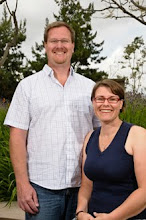
Our move to the country has brought many new opportunities into the lives of our kids. For example, they are now able to walk to school, rather than needing to be driven. One of the best, or the worst of these opportunities - depending on when you ask their opinion - has been the chance to learn to do some significant jobs around the house to earn pocket money.
Over the two weeks of the school holidays, Jeff and I taught the three older kids their new jobs. They took to most of them quickly, though Anna and Abigail will continue to need my supervision or assistance over the next term as they continue to develop the required skills.
Abigail now knows how to use the washing machine. It was funny watching Abi remember the steps to getting the settings correct:
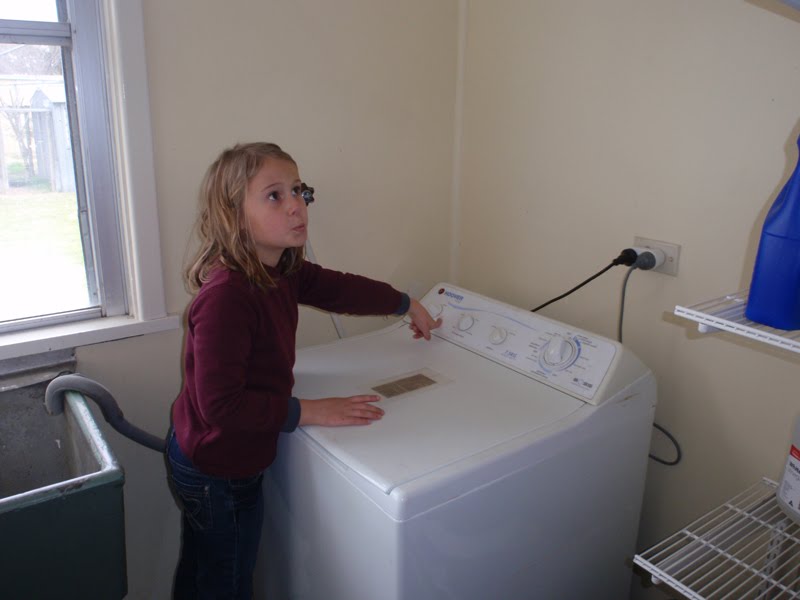
One cause of distress was the broken cold water solenoid which led to a flooded laundry. We learnt to appreciate the benefits of a floor with a (heretofore mysterious) slope. But mostly the washing has been a fun job for Abigail.

She also transfers the washing to the dryer as required and sorts the dry washing into each person's pile before folding her own washing and folding the linen with my help. I have really appreciated Abigail's work for the family, and she has loved earning $2 pocket money each week.
Anna has been tackling jobs in the kitchen, especially baking a loaf of bread each day for the school lunches. There is no regular locally made fresh bread available from the stores here. Although the convenience store does bake some days of the week, these are not predictable. So Anna has been responsible for setting the breadmaker each evening for weekday lunches, and first thing in the morning for warm bread for weekend lunches.

Anna also sets the table, dries the dishes, and helps cook whenever we have time to help her to help us. For these kitchen jobs, Anna has been earning $3 each week, and enjoying the reward of tasty home cooked bread each morning for breakfast as well.
Joshua has the job that requires the most muscles! He splits and stacks the wood for our fire most days, or whenever the firewood stack in the mudroom is getting low. He also cleans the fireplace door each morning before he lights the fire or stokes it up again:

Making sure the wood supply doesn't get too low is an essential task in a town where we have woken up several mornings to frost on the lawn or fog in the air. Joshua earns $4 each week, and we are grateful that he likes to get up early and perform his jobs promptly, often before several other family members have even risen from their beds.
From the time the kids have been old enough to walk carrying something they have been responsible for taking their meal dishes to the sink with scraps in the bin on the way. They've also been responsible for keeping their bedrooms moderately tidy, making their beds each day, taking their dirty clothes to the wash basket, putting their clean folded clothes away, and other personal chores. However, up until this time we have not been paying the children pocket money, although we have paid them for occasional jobs around the house when they have asked to earn some money for a particular purchase. So their first Pay Day was occasion for many smiles!

PS: Samuel has a job as well, which he completes to earn 50c each week. His job did not begin until after the holidays, when we were given a special gift by one of the ladies from our church. More on that in another post.
Saturday, 28 July 2012
Jobs to earn pocket money #1

Saturday, 21 July 2012
Storing and Organising Lego
To the astonishment of many, our substantial Lego collection is now sorted.

Yes, the seemingly impossible has now been achieved.

When a Lego collection gets as big as ours, it can be hard to locate that certain piece you want to make a particular creation. Sorting by colour makes the finding process just that little bit easier. We have sorted our Lego by colour for over a year now, but we have recently bought a few new boxes to streamline the process.
I do a major colour sort at the end of each school holiday, about every three months. In between times, Lego is either put away properly by colour or just put into one large Unsorted Box. Sorting this box is the task for the end of the holidays, or earlier if it gets too full too quickly. It takes about a day to sort one 50L tub, with breaks and distractions, unless I have help - which can make the task take longer, if the help consists of diverting the unsorted Lego pieces to unfinished Lego creations!
We have boxes with dividers for individual colours:

We have boxes without dividers for the black, dark grey, light grey and white pieces, since there are so many:

We have a box for the base plates:

We even have a box for all those clear pieces, and another for several hundred Lego people, several dozen horses and all their accoutrements:

Best of all, almost all of the boxes fit neatly under our bed, ready to be brought out on the weekend.

Sunday, 15 July 2012
Jeff's induction
Jeff's induction was led by Rev John Campbell on behalf of the Baptist Churches
of Western Australia. (John is the pastor who baptised me.)
Questions to and affirmations from Jeff on his calling to the ministry of the C-F Baptist Church:
Question 1: Do you believe in the one God, Father, Son and Holy Spirit, and in Jesus Christ as your Lord and Saviour?
Question 2: Do you believe that the Bible is the inspired, trustworthy Word of God and is the authority on all matters of faith and conduct?
Question 3: Do you promise to fulfil your calling with integrity; preaching, leading, pastoring, teaching, doing the work of an evangelist and equipping the Church for ministry and service?
Question 4: Do you enter, with a willing heart, this ministry for which you have been called? Do you, with God's help, promise to lead and serve the Church with energy – mental, spiritual and physical? Do you commit to enter into the local community, assisting the congregation to effectively live and proclaim the Gospel of our Lord Jesus Christ? Do you respect the congregational authority of the Church?
Question 5: Do you commit yourself to the regular searching of the Word of God and to prayer, for your personal spiritual welfare and for your effective ministry in the Church of God?

Questions to, and affirmations from the members of the C-F Baptist Church:
Question 1: Will you the members of the C-F Baptist Church accept as your Pastor Jeff J, for the living and proclaiming of the Gospel of Jesus Christ?
Response: We will.
Question 2: Will you treat with respect and commit to support Jeff as your Pastor? Will you work with him wholeheartedly as God's people, faithfully upholding him in prayer? Will you love, encourage and enable him to effectively minister to the Church of God?
Response: We will.
Commitment to the J family - Questions to and affirmations from the congregation of the C-F Baptist Church:
Question 1: Will you, the congregation of the C-F Baptist Church welcome into your hearts as family Jeff and Sharon, Joshua, Anna, Abigail and Samuel? Will you faithfully love and encourage them as they minister in the family of God?
Response: We will.
Saturday, 7 July 2012
Tree Change
We've moved to the country!

Our Tree Change tree:

Jeff has a huge workshop shed in the back yard, and there is also a smaller gardening shed. Attached to the garden shed is a source of joy for Samuel: a chook run. Some friends from church have offered us a few chickens on the lay, so we will be making use of the run very soon. Out of the picture is my own personal source of joy: a large rotary clothesline. After nine months without one, after our landlord refused to replace the one that rusted through and fell over at our last home, I was overjoyed to see our new line in the back yard when we moved in.
Thank you, God, for blue sky and sunshine.
Thank you, God, for an outside washing line!
Inside, things are starting to take shape. I can't say the rooms are starting to feel like home, though. We felt at home from the first moment we walked through the door! I'm pretty sure the lovely pale yellow walls had something to do with that.
Our family lounge room, with our potbelly fire (and a box of paper and cardboard moving leftovers to help get the fire started each morning):

The dining room, complete with new dining table, which we purchased second hand for $300 from our old neighbours, along with four new chairs (two of which now reside in the lounge room until needed).

Our new kitchen:

Our bedroom, my side:

Our bedroom, Jeff's side:

I took these photos to remind me how tidy certain rooms can be. However, we have by no means unpacked everything. Jeff's office, now that we have bought five new bookshelves from IKEA, is starting to look like an office instead of a book box collection. But my study, which will also be the toy storage room, is still full of yet-to-be-unpacked boxes and missing a desk, which awaits a few finishing touches in the workshop shed.
Even those rooms that are pretty much unpacked, although not fully ordered and sorted, show the impact of four kids (plus a new friend):


Wednesday, 30 May 2012
Today I went from this...

To this:

And then the girls each had about 10cm chopped off as well.

We are all very happy with our haircuts and looking forward to the girls taking responsibility for the care of their own hair now it is not too long for them to brush on their own. Anna was very excited to find out that with her hair shorter and thus lighter, she has a wave or even a slight curl in it, which we never knew before.
And for anyone who remembers the last time I went from long to short like this, no, I am not pregnant and hormonal this time!
Monday, 28 May 2012
Best Mothers' Day Gift Ever!!

See that bull's eye? I got it with a 9mm Sig Sauer at 15m. Not bad for the first time I'd ever shot a gun!

Jeff and the kids bought me 50 rounds with a .22 revolver and 60 rounds with the 9mm semi-automatic for my Mother's Day gift a few weeks ago. I generously shared my ammunition with Jeff. The kids were not invited to join us, for obvious reasons; we went while they were at school. It was a whole lot of fun, once I worked out how to aim the things!
Friday, 25 May 2012
Reflections on Old Testament Law and History #5
A final contrast is found in the centre of 1 Samuel, where three relationships with David are described. Jonathan ‘made a covenant with David because he loved him as himself’ (1 Sam. 18:3). Michal ‘was in love with David’ (1 Sam. 18:20) and was given to him in the covenant of marriage (1 Sam. 18:27), but later despised David and bore him no children (2 Sam. 6:16,23). Sandwiched between is Saul, who is so angry at and jealous of David that he tries to kill him twice (1 Sam. 18:9-11).
Though these three relationships were all historical, metaphorically they illustrate three ways of relating to God’s ultimate king, Jesus. Saul may be interpreted as a metaphor for the new atheists and others who seem angry and afraid of Jesus while claiming to be the ones with knowledge (in Saul’s case, power). Michal may be understood as a metaphor for people who have a formal connection to the church but no long lasting love for Jesus.
I considered: how am I like Jonathan in my relationship with King Jesus? Just as Jonathan surrendered to David his robe and tunic, sword and bow (1 Sam. 18:4), I have recently had to mentally hand over to God my human means of providing for myself, trusting him to provide my husband with a new job in another pastorate. These months of unemployment have been a period of considerable uncertainty for our family, but I made a commitment to trust Jesus in this situation. By God’s grace and with the encouragement of Jonathan’s example, my faith has not wavered.
My brain appreciates patterns, so God caught my attention with these and other incidents, allowing me the opportunity to reflect upon their application for my life. It has been a worthwhile exercise.
Thursday, 24 May 2012
Reflections on Old Testament Law and History #4
As I read 1 Samuel I noticed several antithetical stories juxtaposed in the text: the book begins with the birth of the last judge and ends with the death of the first king, for example. The first chapters of 1 Samuel consider the story of two families, that of Elkanah and Eli. As a mother, I had previously overlooked Elkanah's story and focussed on Hannah's prayer and its results. But when compared with the sons of Eli, Elkanah’s positive attributes are magnified. Elkanah went up to worship and sacrifice ‘year after year’ (1 Sam. 1:3), generously granting portions of the sacrifice to his family with extra for his beloved, yet barren wife (1 Sam. 1:4-5). He was even willing to give up his own son to the LORD (1 Sam. 1:21-23). This diligence in worship and generosity with sacrifice is a stark contrast to Hophni and Phinehas, who regard the LORD and his offerings with contempt (1 Sam. 2:12-17).
I reflected upon these contrasts, asking myself: am I selfish in my worship of God? Sometimes I am unwilling to share what I see as “my worship time” (early morning Bible study, or a church service) with my often noisy or restless kids, so I need to learn from Elkanah’s example. I can be impatient with other people’s worship, wishing the church would do things the way I like; seeking only my benefit, not that of the church. So I must heed the warning of Eli’s sons’ fate. And although I was not willing to give up my children to the service of the LORD at the tender age of three as Elkanah gave up his son, it is my abiding hope that they will all serve him in their adult careers and indeed with their whole lives.
Wednesday, 23 May 2012
Reflections on Old Testament Law and History #3
Another pattern relates to the location where people interact with God. Once instituted at Mount Sinai, the tabernacle is the official place of worship (Lev. 9:22-24) until Solomon builds the temple (1 Kgs 8). Yet significant religious events occur not in the tabernacle or temple, but on mountaintops. This pattern begins when Abraham attempts to sacrifice his son on Mount Moriah (Gen. 22:2). Moses hears God’s call on Mount Sinai (Exod. 3:1-4) and receives the Law on the same mountain (Exod. 3:12, 19–20). Aaron dies on Mount Hor, where his priestly robes are passed on to his son (Num. 20:27-28), then Moses dies after seeing the Promised Land from Mount Nebo (Deut. 34:1-5). When Israel enters the land, they offer sacrifices and Joshua reads the Law at Mount Ebal and Mount Gerizim (Deut. 27:12-13; Josh. 8:30-35). Elijah contends with Baal’s prophets on Mount Carmel (1 Kgs 18:16-40) before being recommissioned by God on Mount Horeb (1 Kgs 19:15-17). The altitude at which these events take place is not solely a reflection of the mountainous terrain of the Promised Land. Indeed, God instigated most of these events and selected their locations, suggesting mountains are generally good places to meet with him.
In contrast, the ‘high places’ of pagan worship were to be torn down by Israel (Num. 33:51-52; Deut. 12:1-2). They were used by Israel before the temple was built (1 Kgs 3:2) and later kings were criticised by the historical author for building them, using them and not tearing them down (1 Kgs 3:3; 12:30-32; 14:22-24; 22:43; 2 Kgs 12:3; 16:2-4; 21:3 etc). The key feature distinguishing the mountaintop events from high place paganism seems to be God’s word, either spoken directly or read from the Law.
So should I, as a Christian, seek God upon mountains? They are sadly lacking in Perth! When I travelled to the USA several years ago and visited the Rockies, the Olympic Mountains, and the Sierra Nevadas at Yosemite, I certainly felt awe for their creator:

 I felt the same fear and awe for the LORD in Death Valley, USA's lowest point, though:
 From this reading, I now understand that it wasn’t until I shared my responses with my husband, praising God aloud, that my awe changed from a pagan high place experience to true Christian worship involving God’s word.
One privilege of being Christian today is my ability to access Scripture any time, anywhere, in the pages of my Bible, on a screen via the internet or an app on my phone, or simply from my mental store of memory verses. I don’t need to climb a mountain to hear God’s voice, but I do need to be ready to listen to his word.
Tuesday, 22 May 2012
Reflections on Old Testament Law and History #2
In another pattern, the Genesis text lists twelve sons not only of Jacob but also of Abraham's brother Nahor (Gen. 22:20-24) and Isaac's half-brother Ishmael (Gen. 25:13-16), yet only six through Keturah, Abraham's third wife (Gen. 25:1-2). The significance of these numbers may indicate their identity as people chosen to be blessed by God; for Nahor's family through intermarrying with Abraham's descendants, and for Ishmaels's family as recipients of the blessing God promised to Hagar (Gen. 21:17-18). By contrast, Keturah's sons are sent away from the Promised Land (Gen. 25:6).
Other people of interest in the Genesis narrative also fail to have so many sons: Lot has two, who become the fathers of the Moabites and Ammonites (Gen. 19:36-38), and Esau has five, from whom descend the Edomites (Gen. 36:2-5, 8-9). The contrast these families provide is evident in the role their descendants play later as bane to the LORD's people. Together with the Philistines, the Moabites, Ammonites and Edomites contend with Israel as the means of God's punishment of his people.
Monday, 21 May 2012
Reflections on Old Testament Law and History #1
In my reading of the Law and History this semester, I observed the plan of God to choose, save, bless and judge his people announced and demonstrated. Yet the process of reading entire books over several days focussed my attention on smaller patterns. This week I'm posting a series on my observations and thoughts on how these apply to the way I understand the Bible and apply it to my life, most of which made it to my final "reflective essay" for my Old Testament Foundations lecturer.
I observed similarities in the events leading up to the marriages of Isaac to Rebekah (Gen. 24:10-51), Jacob to Rachel (Gen. 29:1-20) and Moses to Zipporah (Exod. 2:15-21): each bride was met at a well while watering her family’s flock. While the community well may have been merely a convenient place to meet people, Genesis 24 emphasises God’s sovereignty in providing a suitable wife. This clarifies the nature of Abraham’s descendants as God’s chosen people. Furthermore, perhaps the author of Exodus included this event to demonstrate continuity between the patriarchs and Moses. Moses also replicates Joseph’s marriage, marrying the daughter of a foreign priest (Gen. 41:45; Exod. 3:1; 18:1), again strengthening his connection to the forefathers. These similarities suggest that the author of Exodus was at least aware of Genesis, if not its author.
Friday, 11 May 2012
Wacky Hat Day
Sam, the Box Man:


Reading Aloud: Ranger's Apprentice
Having read Horrendo's Curse by Anna Fienberg, the author of the Tashi novels, in five nights, I decided to tackle another slightly longer term Read Aloud project. After checking out the entire Top 500 children's book list on Dymocks Bookstore's website, I chose the popular Ranger's Apprentice series, by John Flanagan, beginning tonight. I read aloud the prologue and five chapters - no, make that six - before finally closing the book for the night. Admittedly, both the five and six year olds were asleep by this time; it was after 8pm. But Joshua and Anna had begged me for more each time I suggested the previous chapter might have been the last. And from the end of chapter three, Jeff, who was listening from the kitchen where he was busy making fresh fruit juice and washing the dishes, added his voice to the pleas for more reading. An auspicious start, I believe.
Sunday, 29 April 2012
What to read aloud next?
We've finally finished reading the Borrowers books by Mary Norton, taking four months to read 700+ pages of very small text, loving every night of reading aloud. Now I just need to work out what to read next! Any suggestions?
Tuesday, 17 April 2012
Tertullian wrote:
"We, little fishes, after the example of our ikthus Jesus Christ, are born in water."
On Baptism ch. I
(My favourite quote from my research on baptism for Church HIstory.)
Sunday, 15 April 2012
My Baptism
Jeff: Welcome and prayer
Bible readings
Shelley: Matthew 28:18-20
Then Jesus came to them and said, “All authority in heaven and on earth has been given to me. Therefore go and make disciples of all nations, baptising them in the name of the Father and of the Son and of the Holy Spirit, and teaching them to obey everything I have commanded you. And surely I am with you always, to the very end of the age.”
Acts 2:36-41a
Joshua: “Therefore let all Israel be assured of this: God has made this Jesus, whom you crucified, both Lord and Messiah.”
Anna: When the people heard this, they were cut to the heart and said to Peter and the other apostles,
Abigail & Samuel: “Brothers, what shall we do?”
Anna: Peter replied,
Joshua: “Repent and be baptised, every one of you, in the name of Jesus Christ for the forgiveness of your sins. And you will receive the gift of the Holy Spirit. The promise is for you and your children and for all who are far off—for all whom the Lord our God will call.”
Anna: With many other words he warned them; and he pleaded with them,
Joshua: “Save yourselves from this corrupt generation.”
Anna: Those who accepted his message were baptised.
Shelley: Ephesians 1:3-14
Praise be to the God and Father of our Lord Jesus Christ, who has blessed us in the heavenly realms with every spiritual blessing in Christ. For he chose us in him before the creation of the world to be holy and blameless in his sight. In love he predestined us for adoption to sonship through Jesus Christ, in accordance with his pleasure and will— to the praise of his glorious grace, which he has freely given us in the One he loves. In him we have redemption through his blood, the forgiveness of sins, in accordance with the riches of God’s grace that he lavished on us. With all wisdom and understanding, he made known to us the mystery of his will according to his good pleasure, which he purposed in Christ, to be put into effect when the times reach their fulfillment—to bring unity to all things in heaven and on earth under Christ.
In him we were also chosen, having been predestined according to the plan of him who works out everything in conformity with the purpose of his will, in order that we, who were the first to put our hope in Christ, might be for the praise of his glory. And you also were included in Christ when you heard the message of truth, the gospel of your salvation. When you believed, you were marked in him with a seal, the promised Holy Spirit, who is a deposit guaranteeing our inheritance until the redemption of those who are God’s possession—to the praise of his glory.
Sharon: Why I am being baptised
Apostles’ Creed
I believe in God, the Father Almighty,
Creator of heaven and earth.
I believe in Jesus Christ, his only Son, our Lord,
who was conceived by the Holy Spirit,
born of the virgin Mary,
suffered under Pontius Pilate,
was crucified, died and was buried;
he descended to the grave.
On the third day he rose again;
he ascended into heaven,
he is seated at the right hand of the Father,
and he will come again to judge
the living and the dead.
I believe in the Holy Spirit,
the holy catholic Church,
the communion of saints,
the forgiveness of sins,
the resurrection of the body,
and the life everlasting. Amen.
Pastor John Campbell: On Baptism
Amazing Grace
[John Newton]
Amazing grace - how sweet the sound
That saved a wretch like me.
I once was lost, but now I’m found
Was blind, but now I see.
’Twas Grace that taught my heart to fear
And Grace my fears relieved
How precious did that Grace appear
The hour I first believed
Through many dangers, toils and snares
I have already come;
'Tis Grace that brought me safe thus far
and Grace will lead me home.
Baptismal confession
Triple immersion into the name of the Father, of the Son and of the Holy Spirit


What the Lord has done in me
[Hillsongs]
Let the weak say, “I am strong”
Let the poor say, “I am rich”
Let the blind say, “I can see,
It’s what the Lord has done in me.”
Let the weak say, “I am strong”
Let the poor say, “I am rich”
Let the blind say, “I can see,
It’s what the Lord has done in me.”
Hosanna, hosanna
To the Lamb that was slain
Hosanna, hosanna
Jesus died and rose again
Into the river I will wade
There my sins are washed away
From the heavens, mercy streams
Of the Saviour’s love for me.
I will rise from waters deep
Into the saving arms of God
I will sing salvation songs
Jesus Christ has set me free.
Hosanna, hosanna
To the Lamb that was slain
Hosanna, hosanna
Jesus died and rose again
Let the weak say, “I am strong”
Let the poor say, “I am rich”
Let the blind say, “I can see,
It’s what the Lord has done in me.”
Prayer
Afternoon tea
Why I was baptised today
This is the short talk I gave at my baptism celebration this afternoon: I think of baptism as a bit like a formal, public, citizenship ceremony. At an Australian citizenship ceremony, people officially become Australian citizens. At a baptism, the person is officially recognised as a member of God’s church, a citizen of the kingdom of God. It’s possible, of course, to be a Christian who is a sort of permanent resident of God’s church, without any formal recognition of citizenship. But I want to be an active, loving and serving member of God’s church, so I’ve asked to be baptised. I’ve chosen to be baptised by full immersion, according to the rites of the Baptist Church, which I believe reflect well the original New Testament practice of baptism of new Christians.
Hopefully, it won’t surprise most of you to hear that I am not a new Christian. I became a Christian on Ash Wednesday, the 28th of February, in 2001, in the middle of an Alpha course. So you might wonder why it has taken me over a decade to decide to be baptised.
Well, I was baptised – by sprinkling of water according to the rites of the Uniting Church – at the age of 12. But at that time I wasn’t a real Christian. It was sort of like being made a citizen of a country that I hadn’t even visited (though I knew people who lived there).
I wasn’t a Christian because I didn’t understand what it meant to be saved by Jesus. I understood that I should obey God. But despite attending classes with the minister, I didn’t really understand that when Jesus died on the cross, he – Jesus – took the punishment for my sins completely. Because of what Jesus did, his righteous and goodness became mine. So I didn’t have to win God’s approval by my good behaviour. I just had to allow myself to be saved!
Baptism is, of course, a public recognition of trusting in Jesus Christ as one’s Saviour. So my baptism at the age of 12 was essentially worthless. But when I became a new Christian, I didn’t understand that. I was new to Christianity and I had a lot to learn about what it meant to be a Christian. Recently, I’ve been reading and studying about baptism, and I’ve seen friends get baptised as new Christians, and I’ve been challenged to rethink the idea of my own baptism. Today, as I’m baptised, I am announcing to you that I really do trust in the power of Jesus’ death and resurrection to save me from the consequences of my sins, so I can have eternal life in joyful fellowship with the LORD God.
The Apostles’ Creed sums up what I believe about God. It has been recited at baptisms since the earliest times, and I am going to repeat it today. If you are a Christian, you might like to say it with me now.
I believe in God, the Father Almighty,
Creator of heaven and earth.
I believe in Jesus Christ, his only Son, our Lord,
who was conceived by the Holy Spirit,
born of the virgin Mary,
suffered under Pontius Pilate,
was crucified, died and was buried;
he descended to the grave.
On the third day he rose again;
he ascended into heaven,
he is seated at the right hand of the Father,
and he will come again to judge
the living and the dead.
I believe in the Holy Spirit,
the holy catholic Church,
the communion of saints,
the forgiveness of sins,
the resurrection of the body,
and the life everlasting. Amen.
I am truly grateful to God for choosing me (as Shelley read from Ephesians 1) to be pure and blameless in his sight. As I am baptised in this water today, it will be a symbol of the washing that I have already received, when God washed away my sins and made me a new creation, righteous in God’s eyes.
So these are the three reasons that I am being baptised today:
Because I want to be publicly recognised as a faithful citizen of the kingdom of God;
So I can make a public announcement to you that I do place my faith and trust in the saving power of Jesus Christ, through which my sins have been forgiven and my eternal life with God the Father has been guaranteed;
And as a public sign that my sins have been washed away by the act of Jesus’ death, and now I am a cleansed, purified, new creation who has been made righteous in God’s sight.
Thankyou, my friends, for coming to bear witness to this public testimony of my faith in Jesus.
Friday, 13 April 2012
What does baptism mean?
Being baptised is, in a sense, being made - officially - a Christian. It's the rite of initiation which grants membership to the church. Some early Christian writers saw it as granting entrance not just to a particular church, but actually granting citizenship to the kingdom of God. So you might think of baptism being a Christian citizenship ceremony, which makes official what is recognised: that the person's allegiance is now to God through his Son, Jesus Christ. Just as a person could be a permanent resident of Australia without being a citizen, it is possible to be a Christian without being baptised. But just as citizenship confers particular benefits and responsibilities (voting, jury duty), baptism confers the benefits of being publicly recognised as a Christian.
Baptism has a whole lot of other, deeper, meanings as well. It is a sign that the person is linking themselves to the death, burial and resurrection of Jesus. They are "dying" to a lifetime of sin and selfishness, and being "resurrected" to a life of love of God and service for him, an act which is only possible because of Jesus' death and resurrection. Another way of looking at baptism is to think of it being a bath, but not one that washes off dirt: instead, baptism symbolically washes away the person's sins. In the early church, the time of baptism was seen as the time when a person received the Holy Spirit. From then on, God's Spirit lived in the baptised person, protecting them from evil and guiding them to live rightly. The baptism was seen to be granting "enlightenment" because once the Holy Spirit was living in a person, he would give them understanding and wisdom that an unbaptised person would not have. Baptism was also described as "dyeing" because the person was completely changed - made new - by the process of being wet, just as a piece of cloth wet in dye is completely different when it comes out from the dye.
In my case, I am being baptised by a retired pastor of the Baptist denomination, in accordance with the rites of the Baptist group of churches. Some denominations recognise other's baptisms, and some do not. For example, I don't think the Catholic Church recognises any other denomination's baptismal rites as being meaningful (or at least they didn't until very recently). However, a Baptist baptism would be recognised by the Anglican or Uniting denominations.
Some denominations insist that a proper baptism occurs a certain way. For example, many Open/Christian Brethren and Baptist churches would only allow membership to people baptised by immersion (that is, one's entire body gets wet in the process), unless some sort of sickness prevents the person from getting well and truly dunked. This insistence is partly because these churches believe that immersion was the original way that baptism was done. It is also because of the symbolism involved in identifying with Jesus' death (when one goes completely under the water) and new life (when one is then brought up out of the water). The apostle Paul wrote about this in his letter to the Romans:
"Or don't you know that all of us who were baptised into Christ Jesus were baptised into his death? We were therefore buried with him through baptism into death in order that, just as Christ was raised from the dead through the glory of the Father, we too may live a new life.
For if we have been united with him in a death like his, we will certainly also be united with him in a resurrection like his. For we know that our old self was crucified with him so that the body ruled by sin might be done away with, that we should no longer be slaves to sin - because anyone who has died has been set free from sin."
The Anglicans and Presbyterians generally baptise by sprinkling or pouring water over the person, rather than by immersion, and I have seen both done in Uniting churches. In my case, the baptism I had (by sprinkling) in the Uniting church would not be considered enough to allow my membership in most Baptist churches - which could be a problem if Jeff wants to be employed as their pastor!
Many immersion-only churches also generally insist on baptism only being performed on people who actively profess to believe in salvation through Jesus Christ, rather than (as for the Anglicans, Catholics and Presbyterians, for example) allowing the baptism of infants, who are usually babies of Christian parents. I wasn't a real believer at the time of my baptism, which to my mind makes that baptism worthless. If you think about my citizenship analogy, my baptism was kind of like someone else making me a citizen of a country that (at that time) I'd never been to and had no real interest in.
On Sunday, I am going to be baptised by immersion in the Swan River. Jeff and John will pray for me and my friend Shelley and my kids will read some passages about baptism from the Bible. I'll "make my confession" (give a short talk on why I am being baptised). I will also recite the Apostles' Creed, a simple outline of what I believe as a Christian, which was first used during early Christian baptisms in a question and answer format. Once in the water, I will kneel down and John will bow my head forward into the waters three times (symbolic of the three persons of the Godhead; Father, Son and Holy Spirit). We'll also sing two songs, "Amazing Grace" and "It's what the Lord has done in me". I happen to be doing a research paper on baptism in the first three centuries AD at the moment for college so the liturgy (procedure) for my baptism is somewhat influenced by early baptismal practices!
Tuesday, 3 April 2012

Wednesday, 14 March 2012
The Patriarchal Narratives
 I've just finished writing a book review on Essays on the Patriarchal Narratives for my Old Testament Foundations class, and I'm posting it here as well. It's pretty dense - I had a word limit of 1500 +/- 10%, and managed to get down to 1648 words - and because of that, I didn't get to write much about the significance of the implications of this book. So I'll preface this posting of my review with what I would have included if there had been room.
---
The historical reliability of the stories of the patriarchs Abraham, Isaac and Jacob, which is the subject of the book, underpins several Christian doctrines:
With respect to the faithfulness of God, there are implications for Christians, who rely upon God's promises of Jesus' return in glory to judge and renew creation. If God really did make and keep the promises to the patriarchs recorded in Genesis 12-50, then Christians have a sound basis for their faith that he will keep the promises recorded in the New Testament.
With respect to the relationship between God and his people, there are implications for Christians, who are God's chosen people today. The sovereign nature of the God who elects his people in mercy is discussed in Romans 9:7-16 with particular reference to the patriarchal narratives as the doctrine's foundation. If God really did choose the patriarchs in order to bless the whole world through them (Genesis 12:3 and 28:14) and to have a relationship with them (Genesis 17:7), then Christians have a sensible reason for trusting in his election of the saints (1 Peter 2:9-10) and in God's provision of the perfect priest through whose sacrifice we are sanctified (Hebrews).
With respect to the relationship between God's people and their home, the implications for Christians apply to both the land of Israel - is it still the land of promise, or does that mean something different since the time of Jesus? - and the eternal land of promise: heaven and the new creation. If God really did grant a land for his people (Genesis 15:18-20), then Christians have a strong foundation for their hope in the reality of a new creation (Revelation 21-22).
---
Now you know why the content of this book is important, you might like to read what I thought of it.
Millard, A.R., and D.J. Wiseman, ed. 1980, Essays on the Patriarchal Narratives (Leicester: Inter-Varsity Press).
Essays on the Patriarchal Narratives contains seven essays by seven scholars, examining the archaeo-historical background and literary content of the patriarchal narratives contained in Genesis 12–50. They assess relevant scholarship in various disciplines, and present new analyses of data from their fields, seeking to support the historicity of the biblical accounts of Abraham’s family and their origins in the Ancient Near East (ANE) during the second millennium BC. These essays provide a broad, comprehensive and convincing analysis of studies of Genesis, although it is fairly inaccessible for the novice biblical historian.
The book begins with John Goldingay’s essay, which sets the tone for the entire book. Goldingay exegetes the central theme of the patriarchal narratives as God’s blessing, promised and provided, despite problems and people (pp.12-23). He argues for the examination of the patriarchal narratives in the context of the story arc from Genesis to Kings (pp.25), showing that the theme is derived from God’s blessing of the whole world in the earlier chapters of Genesis (pp.26-27), and extended by Israel’s reliance upon the promises (pp.28-35). Later generations based their faith on the authenticity of the promises and their partial fulfilment as recorded in the patriarchal narratives: ‘Israel … refers to it … in such a way as to make it rather clear that she understands the story to be fundamentally factual’ (p.39-40). Goldingay considers the approaches of T. L. Thompson, G. E. Wright and von Rad (p.35-39) and, finding them lacking, concludes we must take the ‘risk’ of faith, given the inherent credibility of the narratives (p. 40).
The second essay by A. R. Millard, argues that the patriarchal narratives should be studied as ANE texts (p.45), not compared to culturally and chronologically remote texts (such as the Icelandic sagas), and highlights the importance of comparing multiple texts from a range of sources and dates before conclusions are drawn (p.47). He asserts the patriarchal narratives should be considered reliable until proven otherwise, without allowing the religious element to automatically label the text mythical, as would be the case for comparable ANE texts (p.53). Millard promotes a critical but not hypercritical analysis of the text, searching not only for archaeological anachronisms but also for evidence of reliability (p.56), a task his fellow writers strive to undertake.
In the third essay, J. J. Bimson considers possible time frames for the patriarchal narratives. From Genesis 12—38, he distinguishes between sites associated with Abraham’s life and later sites (p.68-69). He then assesses the evidence for dates of occupation from each of the major biblical archaeological sites individually (p.69-79). Bimson argues for a Middle Bronze Age I date for Abraham and Isaac and a Middle Bronze Age II date for Jacob and sons (p.80), which agrees with the majority of the archaeological evidence (with some discussion of possible solutions to conundrums posed by Hebron and Ai [p.80]). He then compares this to intra-biblical dates (p.81-83), achieving a consensus dating Abraham’s life primarily to the 21st century BC (p.84).
The fourth essay, by M. J. Selman, continues the examination of archaeological data, considering parallels that may be drawn between ANE social customs (observed or extrapolated from relevant cuneiform texts) and the practices of the patriarchs. Selman assesses where scholars have overreached in their attempts to draw parallels (p93-102), and where the best balance of support lies from the presently available cuneiform evidence. Granting of birthright privileges to eldest sons, the role of brothers in arranging marriages, and the use of slave girls as surrogates for barren wives (p.126-128) are used as indirect supporting evidence for the historical background of the patriarchal narratives (p.125) and the basis of their content in events of the 2nd and possibly 1st millennium BC (p.128), rather than either solely as a 1st millennium construct of the monarchy to justify its existence, or as an imaginary myth with no basis in actual events.
D. J. Wiseman’s essay rejects the classification of Abraham as primarily a nomad, using the biblical text to show that while he re-located several times, he predominantly settled near populated centres (p.139-142). The meaning of Abraham’s description as a ‘Hebrew’ is discussed and its use in characterising him as a wanderer is discounted (p.143-144). In contrast, it is asserted that Abraham was a ‘prince’ according to the customs of the time, a title of distinction with responsibilities for government (p.144-149). The implications of the nomenclature ‘father’ are considered with respect to the timing of the Abrahamic narratives’ composure and their correspondences to Mesopotamian and Egyptian texts (p.149-153). Evidence for possible origins of the name-type ‘Abraham’ are assessed, emphasising the uniqueness of the name, while acknowledging the renaming process (Gen. 17:5) has Mesopotamian parallels (p.153-154).
‘The religion of the patriarchs’ by G. J. Wenham analyses the uses of various names for God, particularly Yahweh, and El and its derivatives, together with religious practices, across the narratives of each patriarch, as well as between passages attributed by critics to different sources and times (p.159-164). He examines and evaluates the work of A. Alt, F. M. Cross, and C. Westermann in this area (p.164-175). Interpretations of the key passage, Exodus 6:3, are discussed, revealing problems with the application of source criticism (p.179-180). Wenham proposes that the pattern of use of the name ‘Yahweh’ within the Genesis text best fits with ‘the Yahwistic editor’ (p.183) conflating the identities of Yahweh and the God of the patriarchs with careful additions of the Tetragrammaton into earlier text (p.183). The God revealed in Genesis is described in unique ways that would not be appropriate if the text had been composed after Sinai or in the monarchical period (p.184-185).
In the final essay, David W. Baker* considers the connections between parts of the Genesis text, showing that it should not be interpreted merely as a conglomeration of discrete passages, although textual units may clearly be distinguished. He examines lexical endings and beginnings that are indicators of time gaps, and subject and location changes (p.190-195). He also delineates repeated word and phrase forms (such as tôledôt [p.196]) and rhetorical forms (for example inclusio and chiasmus [p.197-199]), which serve to unify certain passages. Baker observes that the use of pronouns as anaphora in the text is sometimes incompatible with the source critics’ document hypothesis (p.200). He states that his analysis cannot be used to determine a definite date for textual composition, although it compares favourably with ANE texts at the structural level (p.201).
The individual arguments are well reasoned, balanced, and flow clearly both within each essay and throughout the order of the book, despite being written by scholars with very different spheres of expertise and interest. Furthermore, coverage of the topic of the historical origins of Genesis 12—50 from a broad variety of perspectives gives weight to the argument as a whole, that there are good archaeological and literary grounds for an acceptance of the patriarchal narratives as based in actual historical events, originally recorded near the time of those events. There is a good balance between comprehensive analysis of previous scholarship and presentation of new attempts to reconcile various data with the Genesis text, as proposed in the preface (p.7).
The authors uphold the significance of the Bible, without seeking to distort or twist data or the text to fit what obviously does not fit. They are unafraid to explain where flawed or hasty methodology has led to failed attempts to prove patriarchal historicity. They also expose several difficulties for the documentary hypothesis.
The analysis of Hebrew and cuneiform is generally clear for the reader who knows no Hebrew. Transliteration of the Hebrew, necessitated by the publication’s formatting style, is particularly helpful.
This book has been written for an academic audience, but its utility in strengthening faith in the face of biblical criticism warrants a wider audience. In order for the essays to be read and easily understood by novices to the arena of biblical archaeology, such as pastors, a map needs to be included to show the sites and approximate dating of relevant archaeological digs, particularly the locations of significant cuneiform finds referred to in the text (such as Nuzi, Mari, Ugarit, Larsa and Akkad).
At present, each essay may be read individually. They do form a combined picture, which is, unfortunately, never clarified although it is hinted at in the preface (p.7). The inclusion of a final essay (perhaps by the editors), drawing together the conclusions of each author, would be valuable if the book is to be read by a wider audience.
It is clear from reading these essays that new archaeological finds or publications of cuneiform texts can change the evidence for or against particular theories very quickly. Hence the age of the work, which is now thirty years old, suggests some of it may be already outdated (However, it is beyond the scope of this review to determine where and how.)
For many people, the only challenge to the veracity and reliability of the Old Testament they are aware of is the Creation/Evolution debate, with its implications for understanding God as Creator. However, the historical reliability of the patriarchal narratives underpins significant theological doctrine: the faithfulness of God in making and keeping his promises; and the relationship between God, his people and their home. In arguing for the veracity of the Genesis record of the patriarchs, this book provides supporting matter for apologetics and biblical theology for Christians, who set their hope in promises of God originating with the promises made to the patriarchs.
This book lays bare the scope of threats to the fundamental historicity of the later chapters of Genesis: from form critics who consider the patriarchal narratives to be the product of oral tradition with little basis in historical events, and from source critics who seek to place the final writing of the Genesis accounts during the monarchy and postulate the existence of multiple source documents from which these accounts were drawn. It also exposes the dangers of over-zealous attempts to reconcile the biblical text with hypothetical constructs of life in particular locations and times within the ANE, without clear and balanced evidence. Fortunately, in its wide-ranging and complex examination of the evidence from seven disciplines, supporting the historicity of the Genesis 12—50, Essays of the Patriarchal Narratives succeeds where those it criticises have failed.
---
* David is my Old Testament Foundations lecturer.