Ha! That got your attention, didn't it?
A conversation I had with my 4yo son this morning over cuddles:
Me: I love you, Sam.
Sam: I love you too, Mummy.
Me: I know someone else who loves you. Can you guess?
Sam: Jesus! Jesus loves me!
Me: Yes, Jesus does love you. And I was going to say God loves you.
Sam: God is Jesus.
Me: That's right, Jesus is God.
Sam: God and Jesus are the same, kinda like twins.
Me: You're right. Kind of like twins... did you hear that, Jeff?
Jesus is God. He is the God-man who makes God known to us, in a body we can understand.
Thursday, 4 August 2011
Twins

Hunger Games the Movie (Poster, that is)
I really want to see this movie. Perhaps almost as much as I am looking forward to the November release of Breaking Dawn Pt1, even though all the action is going to be in Part 2. I'm just not sure if I do go to see the Hunger Games, if I'll be announcing myself as a "Capitolist" at heart, or if I can just go as a reader who enjoyed and appreciated the books for all that they are; for their anti-war message and apotheosis plot. Any thoughts from anyone who has read the books by Suzanne Collins?
Tuesday, 2 August 2011
The view over my kitchen sink
Actually, I took this shot through the fence just outside my kitchen window, a metre in front of where Sam was floating a Lego boat in our kitchen sink. The canal next door has been steadily filling this winter, unlike last, when there was not enough rain to raise the ground water table sufficiently. Since yesterday, for the first time, the canal has stayed looking Full even after the rain has stopped, rather than like a snaky line of water between puddles. Over summer it is completely dry.
I noticed this morning that the small lake at the end of our street is looking Full as well. Hooray for rain in WA!
Did you know you can find out how full the dams around Perth are? Just head on over to the Water Corp's site. And there are a few graphs and other information to help understand what is happening in our dams here. It seems we are still well below the average for the past 8 years, but climbing out of the dry hold that last year's lack of rain left us in, with a sudden upswing in the last week. Last year was the dark blue line; this year is the black line.
Again I say, Hooray for rain in WA!
Monday, 25 July 2011
Joshua the Dwarf fights Samuel the Hobbit
:-D


Jeff has made the kids daggers, swords, and (very important!) shields so they can pretend to be the characters that they are hearing about each evening after dinner, when he reads The Fellowship of the Ring to them. Abigail has had a sword for a while, but Joshua made a specific request for an axe to be made so he could "be a dwarf". Samuel's dagger is named "Sting" after the dagger that Bilbo hands on to Frodo.
In between his forays into weapons and armour manufacturing, Jeff has been hard at work creating my desk. He has spent hours sandpapering the legs in the past week since he has recovered from Man-Flu., and is just about ready to glue them together.
Joshua the reporter
Joshua has written a report on fantasy and science fiction creatures these holidays. We have found illustrations online for him to include in his report and colour. I did the typing and formatting, but the words are, with very few exceptions, all his. And the colouring is certainly all his work. You can see the impact of Jeff's reading of The Hobbit and The Fellowship of the Ring upon Joshua's knowledge of dwarves etc very clearly. (The cover illustration is of a Balrog.)


 Star Wars has also been of great interest in our household, enjoyed through the animated TV program Star Wars the Clone Wars, and Lego kits.
Anna the Author
Anna has written a fairy tale during her holidays. She has occasionally asked me for help in spelling certain words, but by working steadily, she has written her own story. She tells me the names of her heroine and hero come from her favourite Pokemon names, one of hem modified slightly. Below I have transcribed her story as she has written it; she wrote 3 1/4 notebook pages in a faint grey pencil which doesn't scan well.
The Race
Once upon a time there lived the kindest princess her name was Roselia Roseade. She was so beautiful that every one loved her and asked her if she would mary them, but every time she would answer no. One day a prince came and his name was Alfa he was verey rick [rich] and soon fell in love with Roselia Roseade, but she said no to him like the she said to the others. One day the prince Alfa asked Roselia Roseade to have a race with her the next week. Roselia was surprised that he asked her to race because everyone knew that she was the fast in the world she was the fastest girl she was the faster then any boy so why would anyone want to race her? So Roselia agryed to take on the race so she and the prince practiced and practiced for the race. On the day before the race the prince went to a place and asked someone for something to win the race with. So the person gave the prince three golden apples. On the day of the race when the race stated Roselia zoomed away and left Alfa at the start line but Alfa rolled a golden apple in frunt of Roselia Roseade so that she picked it up so the prince ran on in frunt but the princess soon got up and realised that she had been left behined so she started the race again, but the prince again rolled a golden apple in frunt of Roselia and again she picked it up and the prince ran on ahed but the princess got up and ran but the prince rolled the last golden apple. The princess triped over the golden apple and fell over. Some people came and took care of her but she said she was fine. Roselia was angry at the prince for rolling the apple so she picked up the apple and rolled it in frunt of the prince so he picked up the golden apple and ran but the apple was hevey so he could not run very fast. Roselia won the race and the next second the prince came so the princess said since you were close second I will marry you and they all lived happly every after.
Holiday Highlights and one Lowlight
We spent the first week of school hols schlepping across the city and up the freeway to North Beach Baptist's holiday King's Club program, "Out of this World". The kids loved it, and we were able to take two kids form our church along on three of the days as well. Sam was able to join in for the first time, attending one full session and two half-sessions as he found the overwhelming noise of the all-in kids sessions, which had lots of singing, a bit overwhelming. It was also a good change to grab a free cuppa and some cake while I did my pre-reading for Trinity, worked a little on something I am writing for another blog, and caught up with some mums I know from when NBBC was our church.
We spent the second week mostly at home, with the kids taking turns to use Mathletics or Reading Eggs with my closer-than-usual attention to see how they were going. I have made a deal with Joshua and Anna that they have to earn a certificate (1000 pts) for Mathletics each week before they are allowed to play any computer games, or visit other sites they are interested in. This morning Joshua earned 450 points, so the target is well within their reach. Abigail and Samuel have to work on Reading Eggs before they can play computer games.
We also watched a few movies: Rango, which made me ask myself "Is this a Christian parable or a Christian parody?" and Ramona and Beezus, which taught the kids to use the word "bilious". Played loooots of Lego, particularly Star Wars. Closely averted Jeff spending just under a thou on 2nd hand Lego on ebay (phew!) and played with mooooore Lego. Went to several birthday parties. I enjoyed sitting in the church service through the entire thing two Sundays in a row as our Missions Committee ran a holiday program for the kids on David Livingstone and I wasn't part of it. It was lovely to partake of holy communion again! The cousins and Auntie Carla came for a visit. The kids also had a playdate with some kids from church while their mum babysat our kids so Jeff and I could attend a Work in Progress seminar at Trinity comparing John's gospel with the Synoptics, which was very interesting.
We caught a train into the city to buy a birthday present for Uncle Michael and stayed for a short visit to the Art Gallery. We love spending time there looking at the exhibits and talking about them. In the main foyer this time was an exhibition of four metal sculptures and a painting of the sculptures. It was only when we looked closely at the painting that we realised it was of the sculpture figures, and then we began to find out which sculpture was which figure in the painting. The kids thought that was a great puzzle.
All in all, a lovely holiday. But what was our one lowlight? The trip to the emergency dept yesterday afternoon to get Abigail's head stuck back together. Part of a disassembled bed frame fell on her at a friend's house and we made the dash to PMH where she was seen and sent home before Jeff had time to take the other three kids home for a quick bath each. (The silvery gleam is the glue.) Abi's fine now, just a little bit sookier than usual, and upset because Anna got to play at Kidzland today rather than her, since she isn't allowed to bounce for a few days. So instead, I'm off to cook a pineapple upside down cake with Abigail to cheer her up.
They'll be back at school and child care tomorrow. :-(
Wednesday, 20 July 2011
My New Adventure, Part II
I was reading back over some old posts and I noticed this one, called "Shameless Brag". It mentions my last Trinity@Night lecturer commenting on my paper for his class, "Have you thought of doing something more challenging at TTC? Say Grad Dip units? Look into it!"
Well, as of last night I have begun my adventure, studying the Grad Dip unit Intro to Biblical Theology. So if anyone else out there is interested in studying at a Bible or Theological College, but thinks embarking on a Graduate Diploma or Bachelor is beyond them, why don't you see if they have a Certificate Level course that you could try to get your toes wet? You might find that an easy way of getting into deeper study. Also, I am already finding that for me, having done the Cert III in Christian Studies, the lecture content at Grad Dip level is not beyond my comprehension. Mind, that was just the first lecture! My BSF studies and the background reading I have done preparing to coach Sunday School teachers each week has helped hugely as well.
I finished reading God's Big Picture by Vaughan Roberts on Tuesday morning, with my first lecture that evening. Each of the chapters of this book had Bible study questions at the end, which were quite effective at driving home the message of the chapter from the basis of a passage from the section discussed in that chapter. I really appreciated, perhaps for the first time, just how completely the New Creation of the New Jerusalem will bring us back to the same state of sinless glory as Adam and Eve enjoyed for such a short time in Eden before the Fall. At last, all the effects of sin upon the world and upon us will be undone and we will be able to enjoy and glorify our Creator as He created us to do from the very beginning. That marvellous future is why one of my kids has Hope for their middle name.
Next step for class reading is According to Plan by Graeme Goldsworthy. I bought it this morning. I need to write a reading report on this in six week's time, just before I head off to Sydney for Oxygen 11. At which point I might note that I was very pleased to find out that my lecturer has moved our lecture-free week back a week, which makes it coincide with our trip for Oxygen. So I won't be missing any of my lectures for it after all!
So, from this week's lecture, how can I describe the Bible?
1. The Bible tells the story:
- from the beginning, Creation to a renewed beginning, the New Creation;
- of God at work, saving His people, establishing His kingdom, and making and keeping coventant (contractual promises);
- that is all about Jesus Christ. In reading the Old Testament we are prepared for Jesus, and in reading the New Testament we are presented with Jesus.
- Pick up your Bible and grab the two testaments in your left (Old Testament) and right (New Testament) hands. Leave out the editorial matter at either end. You will notice that the OT makes up about 75-80% and the NT about 20-25%. There has to be a reason such a big slab of the Bible is there, doesn't there? Given the relative sizes, it seems obvious that the NT will be difficult to understand without the OT.
- Now put the NT down and take the OT and divide it in half (roughly) according to the number of pages. You will find that your left hand holds the books Genesis to Esther, and your right hand holds the books Job to Malachi. The first half of the OT reports the story of God at work, in chronological order with a few overlapping parts. The second half of the OT responds to the story of God at work that the first half told.
- Now put the "reportage" pages down and divide the "response" pages not quite in half but more like 40% to your left hand (that's Job to Songs) and 60% to your right (that's Isaiah to Malachi). The books in your left hand, also called the Wisdom books, interact with the story of God at work; they examine different parts of individual human life (suffering, love, joy, etc) within the context of the story. The books in your right hand, also called the Prophets, interpret the story of God at work, giving commentary on the larger events that affect people on a communal scale.
- Now put the "interacting" pages down and divide the "interpreting" pages into, at left, Isaiah to Daniel, and at right, Hosea to Malachi. Your left hand holds what is known as the works of the Major Prophets, and your right holds the works of the Minor Prophets. The key to these is to remember the Major Prophets are not more important or significant than the Minor Prophets, they just wrote more words.
We also did a lovely schematic of the Old Testament, but since I wrote in tiny writing, there isn't much point in reproducing it here. I was sooo thankful of my BSF and Sunday School studies during this half of the lecture because without them, much of this would be, if not new, at least unfamiliar. As it was, I felt like I was being shown a snapshot of a place that was already quite familiar to me. None of the names were unfamiliar (not even Jereboam and Rehoboam, thanks to the Lord's Learners' studies on the Kings of Israel and Judah last term) and although I might not have known the dates by heart already, they weren't a surprise.
I did appreciate my lecturer's comment on the two commonly held dates for the time of Moses: "the difference is in how you interpret the archaeology; neither date is heretical". He didn't go into the differences, just mentioned this in passing. Thanks to my study of the Life of Moses with BSF, and the extra research I did to satisfy my questions over that very issue, I know what he was talking about. *smile*
Grace and peace to you in Christ Jesus our Lord!
Monday, 18 July 2011
5 books that changed who I am
Meredith tagged me with Ally's meme to list 5 books that have changed who I am. It's almost a month since Meredith tagged me, and I have been thinking about my list ever since. You might think since I am an avid reader, I would have lots of books vying for my top 5. But the truth is, I don't. I must not be reading as many Quality books as I thought... or is it just that I read so many books that whatever I grasp from one is soon lost to the new insights of the next book? I'm not sure. But after much deep thought, I have created a list. You'll have to forgive me, even still, because it isn't exactly a Book List. It includes two books that I actually experienced as courses that were presented to me, rather than reading the books the courses were based upon (although I have since read the books as well). In order, not of influence, but of the time I read them, starting from the earliest significant book:
1. 2001: The Alpha Course: Questions of Life by Nicky Gumbel
This book is a transcription of the lectures that Nicky Gumbel gives in the Alpha Course. I went to Alpha with Jeff back in 2001, after we'd been married for a few months. It changed my life, as I learnt that being a Christian is not something you do, because everything necessary has already been done for you. It changed Jeff's life, as he realised that being a Christian requires you to do something about it. That might seem like a conundrum, but both are true. We are Christians because Jesus Christ has done all that is necessary to save us - but we live our lives Christianly (more and more like Christ) in response to that free gift of salvation. Alpha changed our marriage, because all of a sudden we weren't a neo-pagan married to a nominal Christian, but two Christians united in marriage by God seeking to bring glory to God.
2. 2002: The Five Love Languages by Gary Chapman
Without this book I'm pretty sure I would not have spoken to my mother-in-law for much of the last decade. It opened my eyes to the fact that Betty shows love in completely different ways to the ways I do. It helped me to understand that the things she was doing, she was doing to show love for me, not criticism. My reading this book and discussing it with Jeff made a huge difference in our relationship because all of a sudden I could choose to react to Betty according to her intentions, not my interpretations of her actions. And I could make an effort to show love to her in ways she would accept as well. Now most of our disagreements are usually precipitated by my suffering PMT-related insanity.
This book also made a difference in how I dealt with Jeffrey, as we learnt to appreciate each other's ways of expressing love. I learnt to spend time with him while he did stuff - even if it was just wandering around with him while he watered the chilli trees in the garden after work, and he learnt that he needed to talk to me and not just be with me.
3. 2003 onwards: The Bible, studied with BSF. For the last seven years I have read my Bible with the help of Bible Study Fellowship, aka BSF. I've read and studied Acts, Ruth, Genesis, Matthew, Exodus through Deuteronomy, Romans, John, and now I'm half way through Isaiah. I began reading my Bible shortly after the Alpha course with the help of Nicky Gumbel's Challenging Lifestyle and A Life Worth Living. I joined a Bible Study small group, and read the Bible with them. But it was BSF that helped me put the two together, providing questions to help me study the Bible on my own and getting me together with other women to discuss what we'd learnt, then listening to a lecture on the passage to bring home the Bible truths. BSF has kept me reading my Bible through thick and thin for the past seven years... and BSF has made me apply what I have learnt from all that reading to my life.
4. 2004: The Bible Overview Course by Matthew Brain, Matthew A. Malcolm, Matthew R. Malcolm and Greg Clarke
Matt Malcolm and his wife Bec presented this course to the incoming students at the beginning of Jeff's first year studying for his MDiv at Trinity. It was revolutionary for me because it changed the way I have read and understood the Bible ever since. This course provides a simple 15 stage summary of the significant events in the story of the whole Bible from Creation (Genesis 1-2) to New Creation (Revelation 21-22). Before attending this course (three sessions over two days) I knew that the Bible hung together as one story, but I couldn't really have told you what it was. And I definitely couldn't have said anything about what the story of the Bible as a whole meant for how we should understand each part of it. This course was indeed revolutionary for the way I now read the Bible - each verse, each chapter, each book in its context within the mega-story of the Bible.
5. 2009: The Twilight Saga, by Stephenie Meyer, and Spotlight by John Granger
This might seem like cheating, to list a saga of four books and then to go and add another book that provides a literary analysis of the series, but these books together have indeed changed who I am. Before reading these books, I read a lot of books. But it wasn't until I read Twilight and Breaking Dawn (and the other two books that fit in between them) that I realised that what I learnt about reading and understanding books in Year 12 English actually applied to anything other than the works of Geoffrey Chaucer and Robert Frost. Somehow, despite my A grade, and my voracious reading before, during and after Year 12, I managed to miss that nugget. (A bit like I managed to miss the nugget of the gospel message in years of Sunday School and Youth Group, I imagine.) Yes: Good Books have more than one meaning, and that meaning is often hidden under the surface. Lightbulb! Reading Spotlight - and posts on Granger's Forks High School Professor website - showed me that there was even more to understanding the meaning of literature than the smattering of such tropes as allegory and irony as I had absorbed from Mr Collins, my English teacher. I never would have read John's book if it wasn't for Stephenie's. Now, thanks to John, I can use "alchemical scaffolding", "ring composition" and "anagogical analysis" in sentences and know what I am talking about, even if you don't!
These two just missed the cut:
2002: The Well-Trained Mind by Jessie Wise and Susan Wise-Bauer
This book is the reason why I homeschooled Joshua, Anna, and (intermittently) Abigail for their kindergarten and pre-primary years. And through me recommending this book, it's the reason quite a few of my friends now homeschool as well. While I am not homeschooling this year, and I don't plan to go back to homeschooling long term, this book has made an impact on the way I teach kids in Children's Church and in the books Jeff and I choose to read aloud to our kids (the very term "read aloud" is only in my vocabulary because of TWTM).
2008: Redemption: Accomplished and Applied by John Murray
I read this book for one of the Trinity@Night courses I did. It helped me to understand my salvation on a much deeper level than I ever had before. It took a lot of effort to get through, but the effort has paid off in my having a very good understanding of what it means that I am saved, how I was saved, and how I am sure I am saved.
I'm supposed to tag 3-5 others to keep the meme going, but everyone I would tag (Meredith, Amy, Kellie) has already been tagged. Actually, I would be curious about John Granger's top five. Bet Harry Potter is there...
So I'll just leave you with Jeff's list, in order from most recent to earliest:
1. Total Church by Tim Chester
2. Mere Christianity by CS Lewis
3. The Five Love Languages by Gary Chapman
Thursday, 7 July 2011
A New Adventure
 Next Thursday evening, I am going to be attending Trinity's orientation for new students. Why? Because I am becoming a student once again. I am embarking upon a Graduate Diploma of Divinity, starting with Biblical and Systematic Theology in second semester.
I am very excited! I bought my pre-reading for the first part of the subject, God's Big Picture by Vaughan Roberts, yesterday, and am studying through it one chapter a day to have it read in time for my first lecture on the 19th. I'm only in the second chapter so far and already I have had several questions to discuss with Jeff and one rather heated conversation with him as I struggled to get my head around something. Mind you, I did promise the principal in my prospective student interview that I wouldn't be as argumentative as Jeff was when he studied his MDiv at Trinity. It will help that I can Discuss (it really does need that capital) my questions and Issues (yeah, that needs the capital as well) with Jeffrey at home, rather than only with the lecturers in the lectures. I hope!
Saturday, 25 June 2011
Isaiah makes his main message in the story of Hezekiah
In BSF last week we have been studying the central chapters (36-39) of the Book of Isaiah, which tell the story of Hezekiah, king of Jerusalem. In 36-37, God saves Hezekiah and Jerusalem from the Assyrian king Sennacherib, and his army. In 38, God saves King Hezekiah fro a deadly illness, granting him 15 more years of life. In 39, Babylon sends ambassadors to Hezekiah, and he shows them all his treasures before Isaiah warns him that within a few generations, his own descendants will be taken along with the palace and temple treasures to Babylon as spoils of war.
This week I have also been thinking and reading about the rhetorical technique of chiasmus, which according to Corbett & Connors' Classical Rhetoric for the Modern Student (p394-5) is the "reversal of grammatical structures in successive phrases or clauses. ... it does not involve a repetition of words."
In many Biblical and other ancient writings, chiasmus is used in an expanded form called chiastic structure. A chiastic structure was used to draw attention to the main idea of a passage. Idea or Event A is paralleled by Idea/Event A'. Idea/Event B is paralleled by Idea/Event B'. C is the critical event. The ideas/events occur in the passage in a sequence of steps leading up to and down from the main one: A B C B' A'. Or a longer, more detailed chiastic structure might be outlined in this way: A B C D E D' C' B' A' etc. Thus this pattern forms a symmetrical text. A chiastic structure may also be described as a Ring Composition.
In a Ring composition, the chiastic structure is developed in such a way that "it is a construction of parallelisms that must open a theme, develop it, and round it off by bringing it back to the beginning. ... the meaning is located in the middle." (Mary Douglas, 2007, Thinking in Circles: An Essay on Ring Composition, x.) Interestingly, John Granger argues in his book Harry Potter as Ring Composition and Ring Cycle that JK Rowling's works follow this ancient practice of organising writing with the main message in the middle.
Over breakfast just now, these two trains of thought came together as I read my BSF notes. If Isaiah is written as a ring composition, with a chiastic structure, then this explains why my BSF notes say, "Chapters 36-39 link chapters 1-35 with 40-66. ... The events of chapters 38-39 seem to precede the events in 36-37. However, the outline of Isaiah's book reflects the decline of Assyria and the rise of Babylon as the new enemy." I haven't looked over all of Isaiah, so I can't say for sure that it is a ring composition. But I can see evidence of chiastic structure in the chapters at the centre of the book, and it has drawn my attention:
A 1-35 Judgement to come; also deliverance
B 36 Envoys from Assyria
C 37 God protects Jerusalem from Assyria
C' 38 God protects Hezekiah from death
B' 39 Envoys from Babylon
A' 40-66 Deliverance to come; also judgement
The main or middle message (C,C') is thus that God will save his people; both corporately and individually.
Considering chapter 37 more closely, I can see that there is a chiastic structure there as well:
A 37:1 Hezekiah mourning in the temple
B 37:2-4 Hezekiah asks Isaiah to intercede with God for deliverance
C 37:5-7 Isaiah tells Hezekiah the commander will leave Jerusalem
D 37:8 The commander withdraws, Jerusalem has relief
E 37:9-13 Sennacherib predicts Jerusalem's fall, pridefully
F 37:14 Hesekiah presents Sennacherib's letter to the LORD
G 37:15-16 Hezekiah prays to the LORD, praising Him
H 37:17 Hezekiah reports Sennacherib's insult to the Living God
I 37:18-19 The other nations fell because their gods were worthless, false gods
H' 37:20a Hezekiah asks the LORD to deliver them from Sennacherib
G' 37:20b Hezekiah prays to the LORD, seeking that He be praised
F' 37:21 Isaiah presents the LORD's response to Hezekiah's prayer
E' 37:22-29 Isaiah prophesies Sennacherib's fall, as punishment for his pride
D' 37:30-32 Isaiah prophesies relief for Jerusalem
C' 37:33-35 Isaiah tells Hezekiah the king will leave Jerusalem
B' 37:36-37 God delivers His people
A' 37:38 Sennacherib killed in his temple
The main/middle message (I) of chapter 37 is that all other gods are all false, they cannot save. Only the One True God deserves praise.
And Chapter 38 breaks down to anther chiastic structure:
A 38:1 Hezekiah becomes ill and (through Isaiah) Hezekiah learns he will die
B 38:2-3 Hezekiah prays to God, praising his own faithfulness
C 38:4-6 God will grant Hezekiah life
D 38:7-8 God promises to give Hezekiah a sign, and He does so
E 38:9-14a Hezekiah describes the anguish of his illness
F 38:14b-15a "O Lord, come to my aid! But what can I say?"
F' 38:15b "He has spoken to me, and he himself has done this."
E' 38:15c-16 Hezekiah describes the blessings of his recovery
D' 38:17 Hezekiah prays to God, praising God's love and salvation from sin
C' 38:18 Hezekiah considers the fate of death
B' 38:19-20 Hezekiah prays to God, praising His salvation
A' 38:21-22 The method of God granting health to Hezekiah (through Isaiah) is described
The main message (F,F') of chapter 38 is thus that When we call out to God for help He Himself will save us.
The point of all this chiastic analysis:
God saves His people corporately (the Church) and God saves His people individually (as Christians).
Are you joined to God's people, the Church, gathering with, growing with and loving His people in a local church?
Are you saved?
No other god can save.
Are you relying on something or someone other than the One True God to save you?
God saves His people when they cry out to Him for help.
Have you cried out to God to save you from your sins?
Have you cried out to God to help you with your current struggle or stress?
How has the LORD answered you and saved you?
Thursday, 2 June 2011
Bed Time Read Aloud
 Jeff has finished reading The Hobbit, so we were faced with the decision of what to read next. Rather fortuitously, I accidentally wandered into a bookstore with Samuel yesterday, and found The Great Big Enormous Book of Tashi. And bought it. And brought it home.
Anna has read a few Tashi stories as take-home readers from school, but I wasn't sure if Joshua would be very interested. The Great Big Enormous Book has 988 pages, which by anyone's measure is a little intimidating. Not Joshua and Anna's apparently. Currently, the bookmark rests at page 279, and that's only because Joshua was forced to put the book down to eat his dinner.
And the even better news is this: Joshua and Anna have agreed to take turns taking over the After Dinner Read Aloud session. This evening Joshua read the first Tashi aloud to Anna, Abigail, Samuel and I. He was marvellous!

Sunday, 29 May 2011
Our New Footpath
Samuel says:
We have a new footpath. The workmen made the footpath. We asked them to have morning tea with us to say "Thank you for our new footpath." Their names are Joe and John. Joe lives down our street. The workmen were very happy that we said "Thank you".
The workman said "You can stick your hands into it and make a mark in it, or you can write your name. It will stick in it all the days and last forever." We drawed my name on it. Then I pressed my hands in the wet concrete. It felt like hard stone.
Now we can ride our bikes on it and ride our scooters on it. We will be safe from the cars that drive down our street. We are happy with the footpath.
xxoo Sam


Saturday, 7 May 2011
Fairy School Dropout narration by Anna
Anna read at least one Rainbow Fairy book each day of the holidays. We borrowed a dozen from the library before the Easter long weekend and she had finished them all within a day of returning from Albany, a week later. Easter Sunday was her seventh birthday, and she used some birthday money to purchase a fairy-style b*rbie and is presently playing fairies in the Play Room. Fairies seem almost ubiquitous in the literature for her age and gender at the moment. Some of Anna's birthday gifts were books. From her Uncle Michael, Anna received Fairy School Drop Out by Meredith Badger. This is the email she sent to Uncle Michael the day after she received the book:
Dear Uncle Michael,
Thank you for “Fairy School Dropout”. I received it in the mail yesterday afternoon, when we got back from camping with Grandma and Grandad. I have already finished reading it.
It was all about a fairy and she made friends with a human girl. It was mostly about the fairy and the girl. The fairy was called Elly and the girl was called Jess. Jess’ problem was that she had to do a school project about a volcano. Elly helped Jess make a model of a real volcano with wire, clay and red bubble bath stuff. When Jess returned it to school, her teacher was so excited, that he entered the volcano into the volcano fair. Elly’s problem was that her wand did not work properly. It did not work because her sister Kara bit it. Jess tried to fix it, but it didn’t work out properly.
I enjoyed reading it very much.
Love, Anna
Michael's comment upon hearing that Anna had read the book so quickly was "She's definitely YOUR daughter!" Yes indeed.
Since her birthday, Anna has moved on to slightly longer books such as Audrey of the Outback by Christine Harris (an Australian trilogy) and The Faraway Tree trilogy by Enid Blyton. I read the latter aloud to her and the other children several years ago and now she is able to read it herself. How cool is that?
[Image from http://us.macmillan.com/fairyschooldropout]
The First Pentecost
This is the final children's talk to end the series on The First Easter. It is based on the events Luke recorded in Acts 2:1-41.
---
The First Easter ended with the apostles,
the men that Jesus had chosen to send out as His witnesses
to tell everyone about Jesus, waiting in Jerusalem.
Waiting. Waiting. Waiting.
So listen quitely while I tell you the story of what happened next:
It was 10 days after Jesus was taken back to heaven,
50 days after Jesus rose from the dead,
and the apostles were still waiting, all together in one place.
Jesus had promised that they would get power when the Holy Spirit came upon them.
At last, on the Day of Pentecost, the Holy Spirit came!
There was a rushing sound: Whoooosh! Like a strong wind: Whoooosh!
Then the apostles saw a fire – and they saw little flames of fire.
The flames were resting on each of the people who had waited for the Holy Spirit.
Now, the Holy Spirit had come! The apostles weren’t waiting any longer!
The Holy Spirit was here, filling the apostles with power… and filling them with words, as well.
Words bubbled up inside the apostles like a fountain.
The apostles couldn’t help themselves,
suddenly they were all talking and talking and talking about Jesus!
Soon, a crowd of people gathered. And the apostles kept on talking, telling everyone about Jesus.
Everyone could understand what the apostles were saying:
people from many different countries, who spoke many different languages.
10 days after Jesus went back to heaven, the Holy Spirit came,
filling the apostles with power to tell people about Jesus.
“What does this all mean?” some of the people began to ask.
They were amazed and bewildered. They didn’t understand that the Holy Spirit had come
filling the apostles with power to tell people about Jesus.
So Peter stood up with the rest of the apostles, in front of the crowd,
and Peter began to talk to the people about the Holy Spirit.
“What is happening today is just what was promised in Scripture.
Long ago, through His prophets, God promised to send His Holy Spirit.
Today, God has filled us with the Holy Spirit so that we can tell you:
‘Everyone who calls on the name of the Lord will be saved!’”
Peter told the crowd about Jesus:
“The Jews handed Jesus over to be put to death on a cross,
but it was all part of God’s plan to save you.”
Then Peter said, “God raised Jesus from the dead.
This is what David wrote about in Scripture, writing,
‘God will not abandon Me to the grave, God will not let His Holy One rot.’
David was writing about the King whom God would send, Jesus the King, Jesus the Christ.
God did not leave Jesus in His grave-tomb to rot. God raised Jesus to life,
and we – Jesus’ apostles – are all witnesses who tell you that this is true!”
Lastly, Peter told the crowd, “God has taken Jesus up to heaven,
to sit next to God on His throne. God has made Jesus the Christ-King of heaven.”
Wow! Everyone heard what Peter had said, and understood Peter’s words.
But the people in the crowd did not know what to do next!
“Since Jesus died to save us, what should we do to be saved?
Peter said Jesus is God’s King, the Christ, so what shall we do to obey Jesus as our King?”
Peter had an answer for the people who asked “What shall we do?”
Peter told them to turn away from their sins. Peter told them to be baptised.
Peter promised them that their sins would be forgiven in Jesus’ name.
Peter promised them that the Holy Spirit would come upon them
and fill them with power to tell everyone about Jesus as well.
And so many, many people believed in Jesus and became Christians on the First Pentecost.
Peter told the crowd that his promise was for children as well.
Peter said, “This promise – that your sins will be forgiven and you will receive the Holy Spirit
– is for you and for your kids, for everyone whom the Lord calls to Himself.”
You can choose to turn away from your sins as well.
You can choose to stop doing the wrong thing and start doing the right things.
You can choose to obey Jesus as your King.
If you do, your sins will be forgiven in Jesus’ name.
When you believe in Jesus, the Holy Spirit will come into you as well,
just as the Holy Spirit came into Jesus’ apostles.
And you can tell people about Jesus.
You can tell people that Jesus died, and God brought Jesus back to life.
You can tell people that Jesus is God’s King in heaven, and Jesus is your King too!
Perhaps you can use the First Easter story book that you made
to tell your family and friends about Jesus.
The Holy Spirit will help you to tell people about Jesus.
---
All illustrations are copyright 2011 Chrissie D. She drew them specifically for our program. (Isn't she wonderful?) The illustrations have deliberately been resized to about 10% of their original size to prevent people copying and re-using Chrissie D's original art without permission.
If you would like to use this story, the illustrations or the accompanying program including materials for activities and songs with your children or church or in some other way, please leave a message on the blog and I will get back to you directly.
Friday, 29 April 2011
First Easter 3
This is the text of the story from the second session of the Sunday School program that I wrote for Palm Sunday, Easter Sunday and the Sunday following Easter for 2011. I based the story text on Luke 22:47-24:53 and Acts 1:1-14. This session is based on Luke 24:50-53 and Acts 1:1-14. The story for the first session can be found here. The story for the second session can be found here.
---
Jesus is God’s King, the Christ. The Jews asked Pilate to sentence Jesus to death by crucifixion, so Pilate sent Jesus to the cross. Jesus died on the cross to save us, so we may live in heaven with Him.
On the third day Jesus’ body was missing, because Jesus had risen from the dead. Jesus met Cleopas on the road to Emmaus and showed him that all of the Old Testament points to Jesus. Jesus reassured the disciples: “Everything must happen that is written about me in Scripture.”
After Jesus rose from the dead, He spent a lot of time with His disciples. Jesus lived and ate and talked with His disciples for 40 days after the First Easter Sunday, when He rose from the dead. For 40 days, Jesus taught His disciples about God’s Kingdom and about the Holy Spirit.
Jesus talked with His disciples about the Kingdom of God. His disciples had lots of questions about God’s Kingdom. One day while they were meeting together with Jesus, the disciples asked Jesus, “Lord, are you going to make Israel into a great kingdom again right now?” The disciples thought that now that Jesus had risen from the dead, nothing could stop Him if Jesus wanted to be king of Israel – not the Jewish leaders, not Pilate, not Herod, not Caesar nor any other human leader. The disciples knew Jesus is God’s King, and they wanted Jesus to start reigning as King right away!
But Jesus told His disciples that they didn’t need to know what time God had decided things would happen. That is God’s business, because God is the King in heaven.
Then Jesus told His disciples that soon, they would get power – special power, some of Jesus’ kingly power – when the Holy Spirit came upon them. But first they had to wait!
“Apostles” means “People who are sent out to do a task.” Jesus called His disciples by the name “apostles” because Jesus was going to send them out into the world with a very special message about Him. Jesus told His apostles that when they had some of Jesus’ kingly power, when the Holy Spirit had come upon them, they would tell people all over the world about Jesus. But first, Jesus told His apostles to wait in Jerusalem. The apostles would tell people about Jesus in Jerusalem as soon as the Holy Spirit had come to them. Jesus taught His apostles about God’s Kingdom and about the Holy Spirit, for 40 days.
After 40 days, Jesus led His apostles out to the Mount of Olives, a hill near the town of Bethany. It was only a short walk outside the city of Jerusalem. Jesus lifted up His hands [lift up your hands] and blessed His apostles. As Jesus was blessing them, He was taken up, lifted up into the sky. The apostles watched with their faces tilted upwards [look upwards briefly] until Jesus was hidden by a cloud. Then the apostles couldn’t see Jesus any more. Jesus had been taken up to heaven while His apostles were watching.
Jesus was gone from the earth. Jesus was not with His apostles any more. They stood staring up to the sky where they had seen Jesus covered by the cloud. “What would happen now? Would Jesus ever come back to them again?” they wondered.
All of a sudden the men realised there was someone else with them. It wasn’t Jesus. Standing next to them were two men, dressed in white. They were angels with a message from God, just like the angel messengers that the women had seen at Jesus’ tomb 40 days before. The angels asked the apostles why they were looking up into the sky. The angels said, “Jesus has been taken from you into heaven. Jesus is not in the sky, He is in heaven. And the same Jesus who has gone to heaven will come back. Jesus will come back from heaven in the same way you saw Him go into heaven.” The angels told the apostles that Jesus will come back from heaven.
The apostles wanted to worship Jesus. So they went straight back to Jerusalem, and they worshiped Jesus at the temple, the place where Jews worshiped God. The apostles praised God for sending Jesus. They praised Jesus for dying on the cross to save them. They praised God for bringing Jesus back to life as God had promised in Scripture.
The apostles met together with other people as well. These people were also followers of Jesus. They had seen Jesus after He had died, after God had brought Jesus back to life again. Jesus’ mother Mary met with the apostles in an upstairs room in Jerusalem. Jesus’ brother James met with them as well. Later, James would write a letter to Christians all over the world about what Christians do. But for now, all the Christians were in Jerusalem, praying and praising God. The apostles, with Mary and James, prayed and worshiped God in Jerusalem. They were obeying Jesus’ instructions to wait in Jerusalem for the Holy Spirit to come upon them.
---
All illustrations are copyright 2011 Chrissie D. She drew them specifically for our program. (Isn't she wonderful?) The illustrations have deliberately been resized to about 10% of their original size to prevent people copying and re-using Chrissie D's original art without permission.
If you would like to use this story, the illustrations or the accompanying program including materials for activities and songs with your children or church or in some other way, please leave a message on the blog and I will get back to you directly.
First Easter 2
This is the text of the story from the second session of the Sunday School program that I wrote for Palm Sunday, Easter Sunday and the Sunday following Easter for 2011. I based the story text on Luke 22:47-24:53 and Acts 1:1-14. This session is based on Luke 23:50-24:49. The story for the first session can be found here.
---
The following explanation is part of an activity that our church kids did before the Bible story. It helps the kids to understand what Jesus is talking about later in the story:
When Jesus lived, the Jewish people did not have the same Bible that we have today. The Jewish people called their Bible “The Scriptures”. Today, we call it “The Old Testament”. The Old Testament Scriptures have many books. They include the books called “The Law of Moses”, which were written by Moses. Then came the books called “The Prophets” which told the history of the people of Israel and what God said to them through the prophets God sent. There were also “The Psalms”*, which included the Book of Psalms and some other books such as Proverbs.
* "The Psalms" was also called "The Writings", but in this passage of Luke, Jesus refers to these books as "The Psalms".
---
Jesus is God’s King, the Christ. The Jews asked Pilate to sentence Jesus to death by crucifixion, so Pilate sent Jesus to the cross. Jesus died on the cross to save us, so we may live in heaven with Him.
Jesus was dead. When people die, other people bury their dead bodies. So a man named Joseph asked Pilate if he could bury Jesus’ body. Joseph took Jesus’ body down off the cross on the hill. Then Joseph wrapped strips of linen cloth around Jesus’ body. And Joseph put Jesus’ body in a tomb cut into rock.
The women who had seen Jesus dying on the cross, who had cried when Jesus died, watched Joseph bury Jesus’ body. It was getting late in the day and they could not put sweet-smelling spices on Jesus’ body now. The women would not go near or touch Jesus’ body on the next day, because it was a holy Sabbath day. The women knew they would have to wait until the day after the Sabbath, the third day, to come and put spices on Jesus’ body. So they went home to get the sweet-smelling spices ready for the third day.
Very early on the morning of the third day (it was a Sunday), the women took the sweet-smelling spices and went to the tomb where they had seen Joseph bury Jesus’ body. When the women arrived at the tomb, they got a shock: the big stone that should have been in front of the opening to the tomb had been moved. The stone had been rolled away. The women could see right inside the tomb. But Jesus’ body was missing! They looked and searched but they could not find the body of Jesus anywhere. It was the morning of the third day since Jesus had died, and Jesus’ body was missing. “I wonder where Jesus’ body is!” they said to each other.
And while they were wondering about it, they had an even bigger shock: suddenly two men were standing beside them. Their clothes shone very bright, like lightning. They were angels with a message from God. The angels said to the women, “Why are you looking for someone who is alive in a tomb for dead people? Jesus is not here in the tomb. Jesus is risen!”
The women ran to tell the disciples that Jesus’ body was missing, because Jesus had risen from the dead. At first, no-one believed them. So Peter went to the tomb to look for Jesus’ body. When Peter got to the tomb, he looked inside. All Peter could see was the strips of linen that Joseph had wrapped around Jesus’ body. The linen strips were lying by themselves. Jesus’ body was missing because Jesus had risen from the dead.
Later that day, two of Jesus’ followers were walking from Jerusalem to a nearby town called Emmaus. Cleopas and his friend couldn’t stop talking about everything that had happened to Jesus. And as they were walking and talking, a man came up and began to walk along with them.
“What are you talking about?” the man asked Cleopas and his friend.
They could not believe that the man had not heard the news about Jesus dying on the cross.
“What has happened?” the man asked them.
“Jesus of Nazareth was a powerful prophet,” Cleopas and his friend told the man who walked with them. “The leaders of our people, the Jews, asked for Him to be sentenced to death, and Jesus died on a cross. We had hoped that Jesus was going to save our people. But now it is the third day since Jesus died, and some women told us that Jesus’ body is missing. Peter went to the tomb and found out that the women told us the truth.”
The man said to Cleopas and his friend, “You are very foolish because you do not believe what the Prophets have said. Didn’t you know that God’s King (the Christ) had to suffer? Didn’t you know this had to happen before God’s King (the Christ) could enter His glory?” And the man started to explain to Cleopas and his friend all about what was said in all the Old Testament Scriptures about Jesus. Cleopas’s heart felt like it was on fire inside his chest as he listened to the man begin with the Law of Moses, and then talk about the Prophets. At last Cleopas and his friend understood that all of the Old Testament Scripture points towards Jesus.
Cleopas was very excited. When they got to his home in Emmaus, he invited the man to come in. They sat down to have a meal together. As the man prayed thanking God for the meal and then held up some bread to break it into pieces for each of them, Cleopas suddenly recognised the man. It was Jesus who had been walking and talking with them! It was Jesus! Jesus had risen from the dead!
But then, just as mysteriously as Jesus had come to walk along with them, He was gone. Cleopas ran all the way back to Jerusalem to tell the disciples what had happened. The disciples told Cleopas that since they had left for Emmaus, Peter had seen Jesus as well. They knew it was true: Jesus had risen from the dead!
As everyone was talking together, Jesus came into the room. The disciples were shocked, but they were also frightened. Was this really Jesus, or was it a ghost? Jesus said to them, “I am not a ghost. Look at the wounds on my hands and feet where I was nailed to the cross. Touch me! I am not a ghost.” Then Jesus ate some fish with the disciples to show them He was real. Jesus was not a ghost, Jesus had risen from the dead!
Then Jesus helped His disciples to understand the Old Testament Scriptures. Jesus said, “Everything that is written about me in the Law of Moses, the Prophets and the Psalms must happen. It must come true.”
Jesus explained to them, “The Scriptures say that the Christ, God’s King, must suffer and rise from the dead on the third day.” Jesus died on the cross and then rose from the dead just as God had promised His people long ago, when the Old Testament Scriptures were first written.
Jesus said, “People in every country will be told that they should repent of their sins and their sins will be forgiven in my name, the name of Jesus Christ, God’s King. You have seen everything has happened to Me just as God promised in the Scriptures. Soon you will tell people everywhere about Me.”
---
All illustrations are copyright 2011 Chrissie D. She drew them specifically for our program. (Isn't she wonderful?) The illustrations have deliberately been resized to about 10% of their original size to prevent people copying and re-using Chrissie D's original art without permission.
If you would like to use this story, the illustrations or the accompanying program including materials for activities and songs with your children or church or in some other way, please leave a message on the blog and I will get back to you directly.
First Easter 1
This is the text of the story from the first session of the Sunday School program that I wrote for Palm Sunday, Easter Sunday and the Sunday following Easter for 2011. I based the story text on Luke 22:47-24:53 and Acts 1:1-14. This session is based on Luke 22:47-23:49.
---
It was very late at night. Jesus had been praying in his favourite quiet place, in a garden near a hilltop, out under the stars. Jesus’ disciples were with Him, just as they had been for the three years that Jesus had gone through Galilee and Judea, teaching people about God and doing miracles. In the three years they had been with Jesus, the disciples had learnt that Jesus is God’s King, the Christ.
Only one of Jesus’ disciples wasn’t there in the garden. Judas was missing. Judas did not believe that Jesus is God’s King, the Christ. Earlier, while Jesus and His disciples ate dinner, Judas had left to talk to the Jewish leaders about how he could betray Jesus. Judas had made a plan to bring the temple soldiers to Jesus when He was in His favourite place, away from the crowds. Then the temple soldiers could arrest Jesus in secret. And all at once, Judas was there in the garden. Judas boldly walked up to Jesus, and gave Him a kiss on the cheek [blow kisses] as if to greet Jesus as his friend. But Jesus knew Judas was betraying Him.
When Jesus’ other disciples saw Judas there with the temple soldiers and the Jewish leaders, they wanted to fight to get away safely. But Jesus said He was not leading a rebellion. Jesus knew it was time for the Jewish leaders to do what they wanted with Him.
The temple soldiers arrested Jesus, and they took him to the Jewish council. Jesus was on trial. The Jewish leaders accused Him:
“If you are God’s King, the Christ, tell us!” they said to Jesus.
And Jesus agreed with the Jewish leaders. “You are right,” Jesus said, “I am the Christ.”
The Jewish leaders were outraged! They did not believe that Jesus is God’s King, the Christ.
The Jewish leaders took Jesus to Pilate, the Roman governor. They told Pilate that Jesus claimed to be the Christ, God’s king. The Jewish leaders knew that the Romans said only Caesar could be king. Once again, Jesus was on trial. Pilate asked Jesus, “Are you the king of the Jews?”
Jesus agreed with Pilate. “Yes,” Jesus said, “It is just as you say, I am King.”
Jesus is God’s King, the Christ.
The Jewish leaders were very surprised when Pilate refused to say Jesus was guilty. So then they took Jesus to Herod. Herod teased Jesus. He put an elegant robe on Jesus, dressing him up to look like a king. But Herod didn’t really believe Jesus is God’s King, the Christ. Then Herod sent Jesus back to Pilate.
Pilate didn’t agree that Jesus was guilty. But the Jewish leaders kept telling Pilate to punish Jesus. And now there was a big crowd of people filling the court area. Pilate offered to let Jesus go free, but instead the people shouted that Pilate should kill Jesus!
“Crucify Him! Crucify Him!” the people shouted.
So finally Pilate agreed with the Jewish leaders and the shouting crowds. Pilate sent Jesus to be crucified.
Jesus walked up to another hilltop. It wasn’t peaceful and quiet on this hilltop. Women were crying, terribly sad that Jesus was going to die. This time, there were no stars shining in the sky. It was the middle of the afternoon, but the sun stopped shining, and it was dark for three hours.
On that hilltop, Jesus was crucified. Jesus was put on a cross to hang until He died. On the cross where Jesus was crucified, there was a sign. The sign said, “This is the King of the Jews”.
Jesus’ disciples had been with Him in the hillside garden, but now next to Jesus were two criminals who were also sentenced to die. One of the criminals called out to Jesus in a rude voice:
“Aren’t you the Christ, God’s King? If you are, save yourself and save us!”
But the other criminal believed that Jesus really is God’s King, the Christ. That man said that Jesus had done nothing wrong.
Then Jesus said to the second criminal, “I tell you the truth: you will be with Me in paradise.”
Jesus promised that He would save the criminal, so that he could be in heaven with Jesus.
Many other people teased Jesus, making faces at Him. “Let Him save himself if He really is the Christ, God’s Chosen King,” they said.
The people didn’t understand that Jesus chose not to save himself. Jesus is God’s King, the Christ. And staying hung on the cross to die was the most important job Jesus had to do as God’s King. Jesus was the only one who could do it. Jesus died on the cross to save us, so that we can live with Him in heaven.
If Jesus saved himself, and did a miracle to get down off the cross and make himself safe, we would not be saved from our sin. We would never live with Jesus in heaven. So Jesus, God’s King, the Christ, died on the cross to save us.
---
All illustrations are copyright 2011 Chrissie D. She drew them specifically for our program. (Isn't she wonderful?) The illustrations have deliberately been resized to about 10% of their original size to prevent people copying and re-using Chrissie D's original art without permission.
If you would like to use this story, the illustrations or the accompanying program including materials for activities and songs with your children or church or in some other way, please leave a message on the blog and I will get back to you directly.
Wednesday, 27 April 2011
Easter in Albany
Kojonup playground, on the way down:


Granny's and Gramps's house:
Most of the rest of these photos are from the Strawberry Jam Christian Music Festival at Albany.
On the Jumpy Castle at Strawberry Jam on Sunday. Abi (pink pants), Anna (white top, fallen down), Sam (green top behind Abi) and Josh (white top, black jeans jumping up centre back):
Article One (from Canada) - the violinist was something special!

Petra! Yaaay!
 Not good photos tho' just too dark by that time. They played "Gravedigger", "It is Finished!" and "Judas Kiss" among others. Listening (and singing along to) the songs again made me wish I had listened better to the lyrics the first time I heard them as a teen. I heard them - I still could sing along with them two decades later - but I never took the message in. After the set I spent some time asking God's forgiveness for my stuborness as a teen refusing to listen to the gospel message of salvation through faith in His Son, Jesus.
The girls watching Walter on Monday in the pouring rain:

Fans of Sean W Smith:
 No photos of Sean W Smith playing - I was too busy dancing along to his songs with the kids!
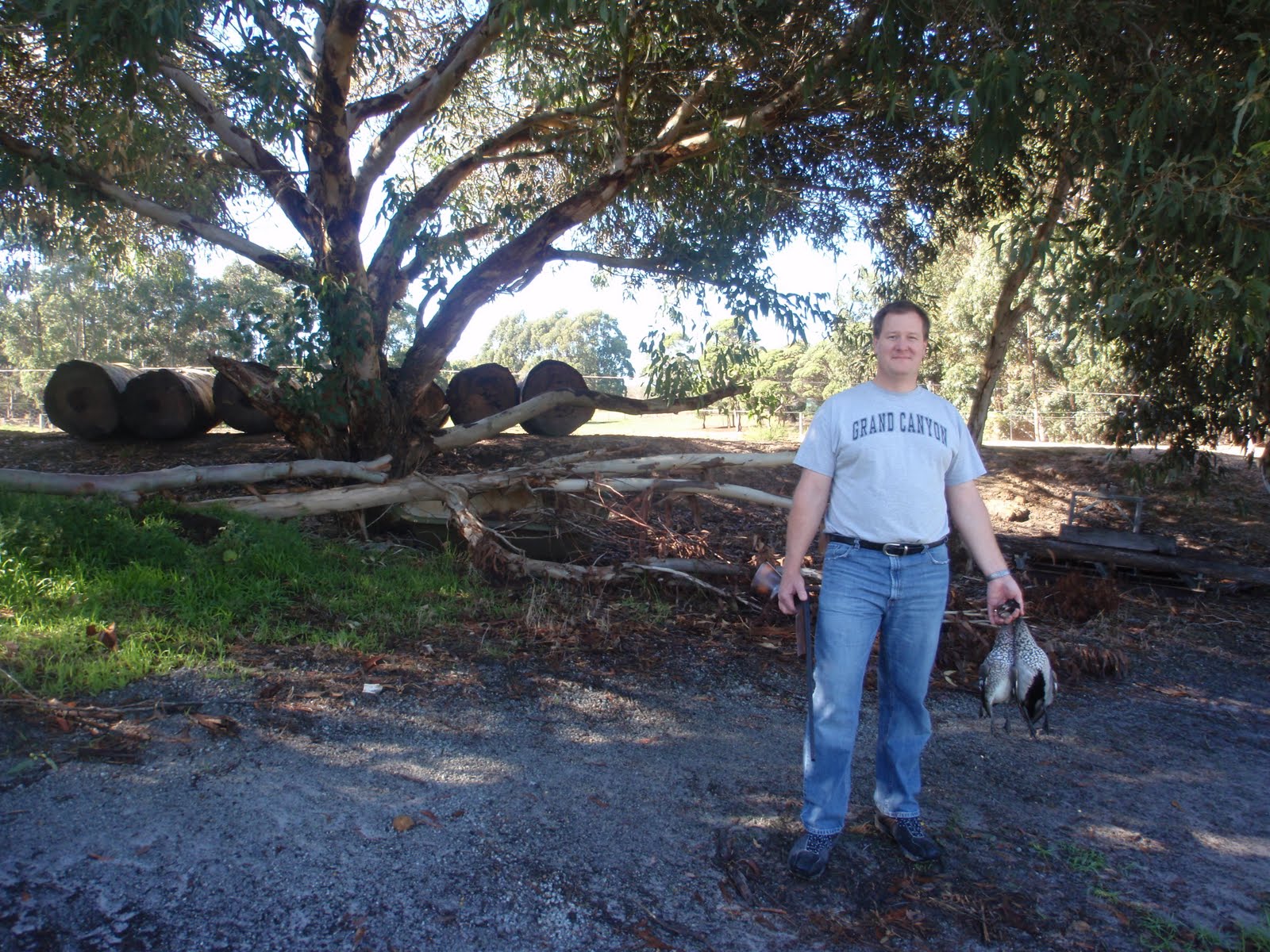
Success at goose shooting on the farm:
Subscribe to:
Posts (Atom)